Court Builder in Tempe, AZ
Apex Courts Arizona LLC, ROC 324026, class KA Dual Engineering, licensed since 2019, 800+ courts built across Arizona, family owned in Phoenix, ASBA member, BBB Accredited.
Apex Court Builders is a family business based in Phoenix, about a 15-minute drive from Tempe City Hall without traffic. In Tempe it builds pickleball, tennis, basketball and multi-sport courts and resurfaces worn ones under Arizona ROC 324026, one license that covers commercial and residential work, grading and concrete included, and court lighting is on the same contract.
Call (480) 264-6889, Monday to Friday 7:00 AM to 5:00 PM Arizona time, or request a free estimate.
Light poles, lumens and the lot line
Under zoning code section 4-803, as Tempe’s guidance quoted it in September 2025, a freestanding light fixture in a residential district or within 50 feet of one may stand no more than 18 feet above the grade at its base. Light from new fixtures may not exceed 0.5 footcandle at a property line next to a single family district, and fixtures without full cutoff are held to 1,700 lumens behind white or opal glass and 600 behind clear or prismatic glass.
For a home court, plan on full cutoff fixtures on poles of 18 feet or less, aimed to keep the light on the lot. The 40 footcandle cap for on-site lighting refers to the exemptions in section 4-805, so ask the city how section 4-803 and those exemptions apply to a home court’s lights.
Fences, permits and historic review
Section 4-706, in Tempe’s guidance as of December 2025, caps fences and walls in side and rear yards at 8 feet for single family uses. A 10-foot court fence on a single family lot is 2 feet over that cap, so ask the city how a taller court enclosure gets approved.
Three city pages set the building permit line at fences and walls over 6 feet and the homeowners guide at 7, so confirm it with the Permit Center. A 2005 city building directive has chain link and other open fences designed like solid fences, with a factor for openness, and asks for engineering drawings and calculations.
In a historic district or on a property in the Tempe Historic Property Register, the Historic Preservation Office’s page says most work located entirely behind the main building, or not visible from the street, can be approved over the counter with a Certificate of No Effect. Tempe’s General Business License took effect August 1, 2025, and the city’s page names contractors with job sites in Tempe among those who need one.
Grading, drainage and two soils
The city’s Single Family Home Grading and Drainage Plan Criteria, revised January 2022, count all improvements as lot coverage, patios and walls included, and require new homes to hold the 100-year storm on site. Private Development Engineering decides whether any construction on a private lot needs a grading and drainage plan and permit, and a plan has to come from an engineer, surveyor or architect registered in Arizona. A court slab adds to that coverage and can add to the water the lot must hold.
The USDA soil survey maps Avondale clay loam, a limy flood plain soil, at Tempe City Hall and Laveen loam, with a lime layer that starts 3 to 34 inches down, at Kiwanis Park to the south. Post holes and light pole footings on Laveen can meet that layer.
Coating days in the heat
Phoenix Sky Harbor, just west of Tempe, averages 111 days a year at 100°F or hotter. Coating data sheets want air and surface at 50°F and rising with no rain due, and one rules out a surface hotter than 140°F, which in summer favors coats at first light. Another wants both above 50°F for 24 hours after a coat. Nights at 50°F or below number 25 or more a month there in December and January but 7.8 in March, 1.8 in April and 0.7 in October, so spring and fall are the easiest months to coat.
Court types
Pickleball courts
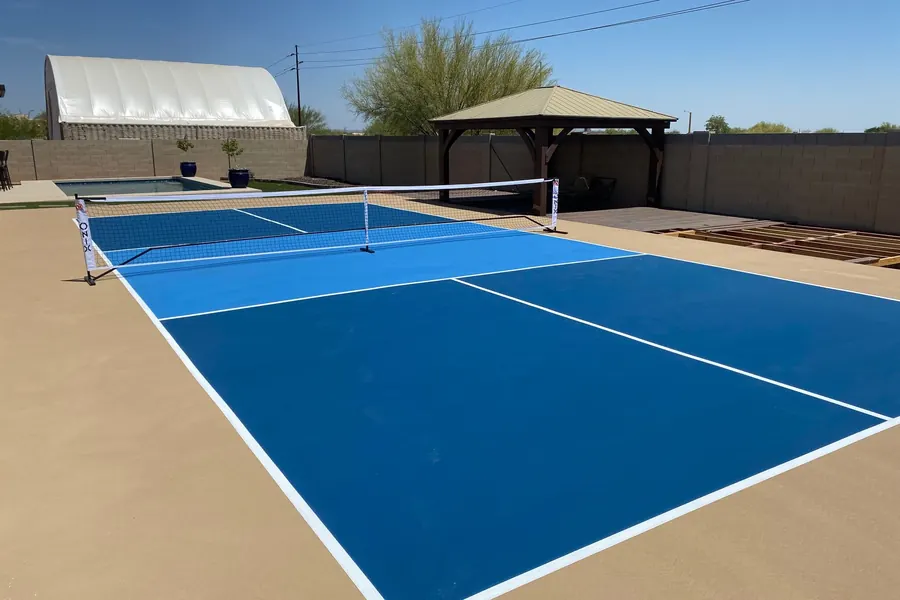
Apex builds backyard, HOA and club pickleball courts, each a concrete slab under acrylic color coats. The city’s pickleball courts at the Tempe Sports Complex are dedicated courts under LED lights, and an expansion that opened in April 2026 doubled them from eight to 16.
Tennis courts
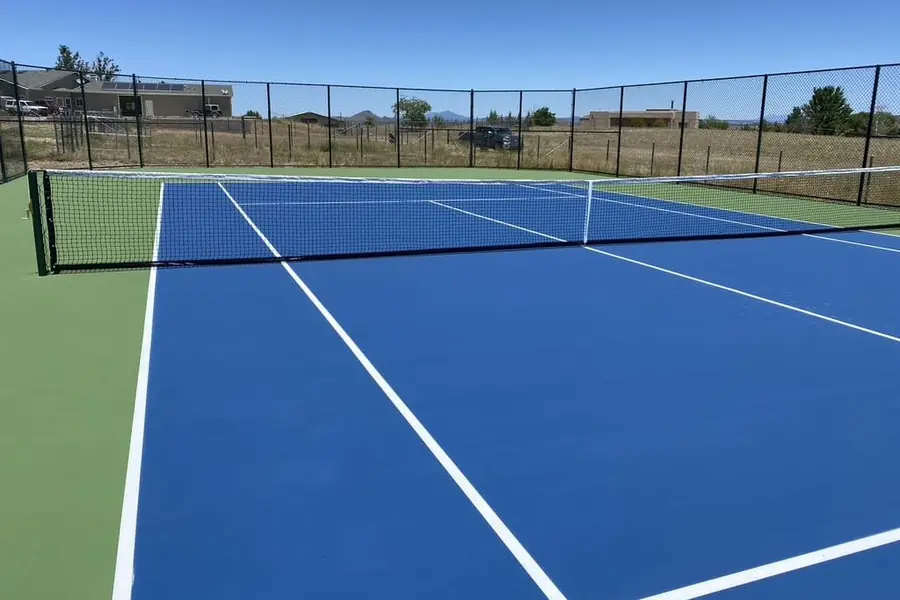
A regulation tennis court with its run-off covers about 60 by 120 feet. A tight lot can take a smaller practice court, and lines in a second color add pickleball to the same slab.
Basketball and multi-sport courts
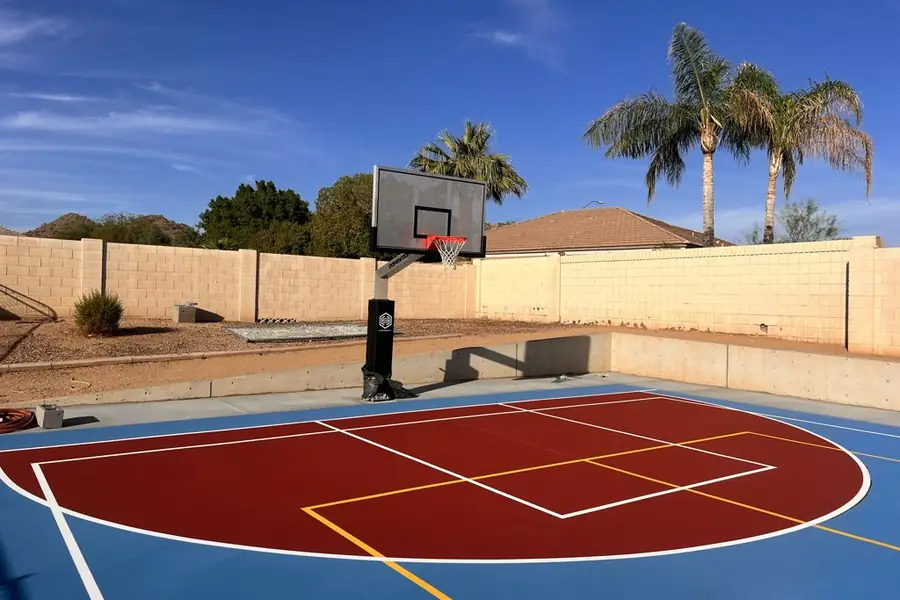
Basketball courts run from a half court to a full court, and multi-sport courts put lines for several games on one slab.
For bocce or padel, see bocce court construction and padel court construction.
Court resurfacing in Tempe
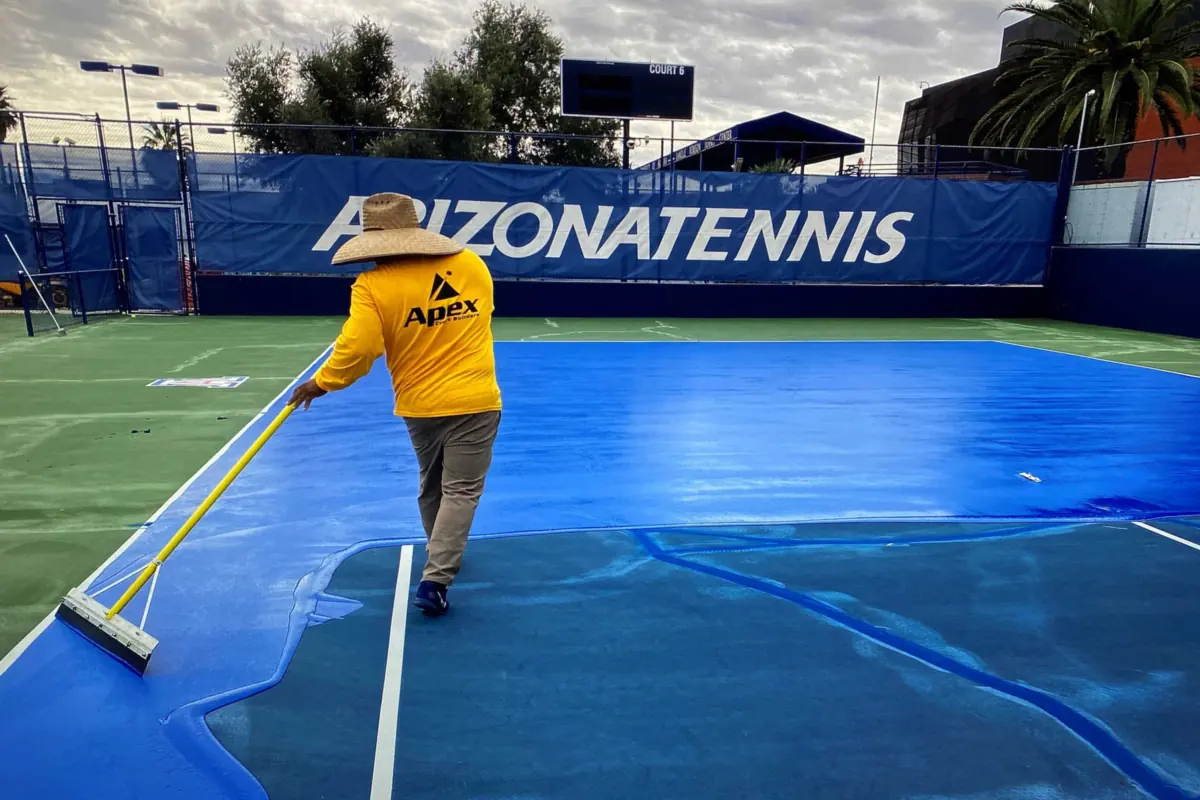
Tennis court resurfacing and pickleball recoats follow one order. The court is cleaned, cracks are repaired and low spots leveled, then an acrylic resurfacer goes down before the color coats and fresh lines. Under Tempe’s sun and heat, an acrylic coat fades and cracks sooner than it would in a milder climate.
On a sound tennis slab, conversion fits up to four pickleball courts with no new concrete. The west tennis court at the city’s Mary and Moses Green Park carries four pickleball areas with moveable nets.
| Services | Court construction, court resurfacing and tennis to pickleball conversions |
|---|---|
| Areas served | Tempe. Other cities are on the service area page. |
| Based in | 705 E. Granada Road, Phoenix, AZ 85006 |
| Hours | Monday to Friday, 7:00 AM to 5:00 PM Arizona time |
| Phone | (480) 264-6889 |
| License | Arizona ROC 324026, class KA Dual Engineering, held by Apex Courts Arizona LLC, licensed since 2019 |
Court questions
How tall can a court light pole be?
Can a court fence stand 10 feet tall?
Does the slab need a permit or a drainage plan?
What soil sits under the court?
Which months suit a court coating?
What changes on a historic property?
How far does Apex travel for the site visit?
Request a free estimate
Every court is quoted per project, and final pricing depends on court size, existing surface condition, crack repair, drainage and low spots, coating system, colors, striping and site access. Tell us where the court is going, whether you want lights and how big the lot is. Call (480) 264-6889 and the owner answers. The consultation is free. Or send the form below and we call you back.