Court Installation in Chandler, AZ
Apex Courts Arizona LLC, ROC 324026, class KA Dual Engineering, licensed since 2019, 800+ courts built across Arizona, family owned in Phoenix, ASBA member, BBB Accredited.
Apex Court Builders, a Phoenix family business, builds and resurfaces courts in Chandler and Sun Lakes. Chandler’s permit manual says work under a permit needs a licensed contractor unless the owner applying does it. Apex Courts Arizona LLC holds ROC 324026, one license that covers commercial and residential work, grading and concrete included, and court lighting is on the same contract.
Call (480) 264-6889, Monday to Friday 7:00 AM to 5:00 PM Arizona time, or request a free estimate.
Court lights and light trespass
Chandler’s zoning code has no outdoor lighting article. The rule that reaches a home court came in February 2024, when Ordinance 5075 barred exterior light directed off the property onto neighboring property. With no lumen cap, fixture choice and aiming keep the light on the court. New court lights need an electrical permit, since the permit manual exempts lamp replacement but not new electric wiring.
Near Chandler Municipal Airport and Stellar Airpark every permit request in the Airport Impact Overlay goes to the Airport Manager, who can rule a pole a hazard and require it lowered or marked and lit.
Fence height and on-lot retention
Chandler caps residential fences at 7 feet in side and rear yards. The city specified 10-foot fencing around its own Tumbleweed Park pickleball courts, and a court fence that tall needs prior Planning approval and a permit. The code also bars double fences or walls unless the Zoning Administrator waives it, so ask Planning whether a court fence inside a block wall counts as one.
Where a subdivision retains stormwater on each lot, the city’s On-Lot Retention Policy counts concrete at a runoff coefficient of 0.95 against 0.50 for landscaping, and any change to the lot, a pool included, needs a revised grading and drainage submittal sealed by a registered civil engineer. A court will likely need one.
County islands and Sun Lakes
County islands, pockets of unincorporated land inside Chandler, follow Maricopa County rules. The county allows a tennis court fence up to 12 feet. Its lighting directives want fixtures fully shielded and aimed below the horizontal.
Sun Lakes HOA #1, whose rules cite a Maricopa County building permit, caps rear walls at 5 feet, bars chain link on lot-line walls and fences, and wants a plot plan for every concrete pad, proper runoff and nothing in the 5-foot easement. Its rules never mention a private court, so a backyard court there starts with the architectural committee. Read your association’s CC&Rs and rules before a design is drawn.
Clay, cure and the coating season
The city’s airport master plan describes fine-grained silt and clay that grow less permeable with depth. Contine, a shrink-swell soil of the eastern Maricopa County survey area, is clay over a lime layer 20 to 40 inches down with slow permeability, so post holes can reach that lime layer and a slab needs a stable base that drains.
For the 18 lit pickleball courts at Tumbleweed Park, the city’s spec called for a subgrade sloped 0.83 percent, 4 inches of compacted aggregate and 5-inch slabs of 4,000 psi concrete, then 28 days of cure before a primer and three sand-filled acrylic color coats. That is the city’s spec for a public complex.
Coating makers want air and surface at 50°F and rising with no rain due, and one caps the surface at 140°F. At the Chandler Heights station NOAA normals count about 95 days a year at 100°F or more, so summer coats suit the early hours and work around monsoon storms from June 15 to September 30. From November through March most nights fall to 50°F or below, which rules out products that need 24 warm hours after a coat. Coats can go on in any season with the product and hour matched.
Courts by sport
Pickleball courts
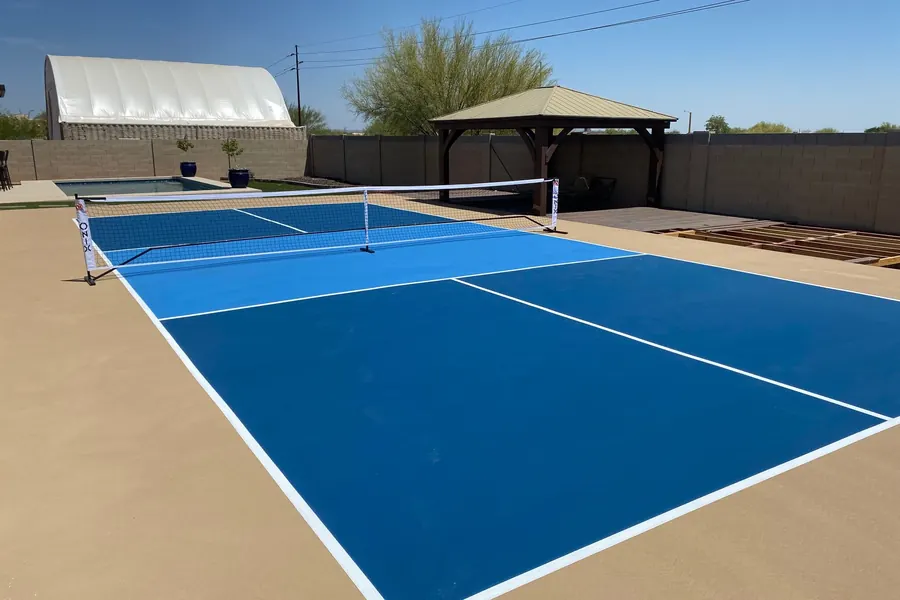
A backyard pickleball court, or a multi-court layout for an HOA or club, is a concrete slab finished in acrylic color coats. More on pickleball court construction.
Tennis courts
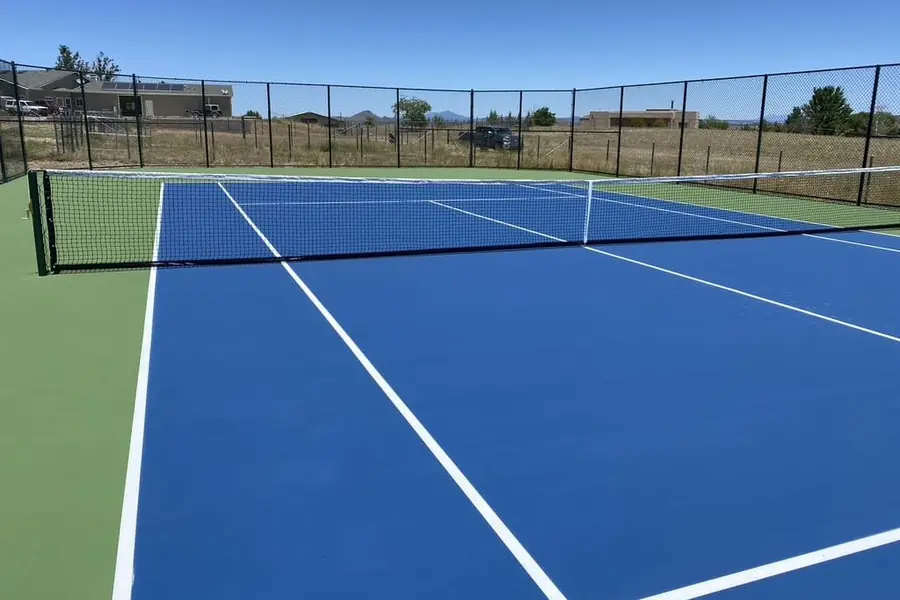
A regulation tennis court with run-off needs about 60 by 120 feet, a practice layout fits a tighter lot, and pickleball lines can go on in a second color. More on tennis court construction.
Basketball and multi-sport courts
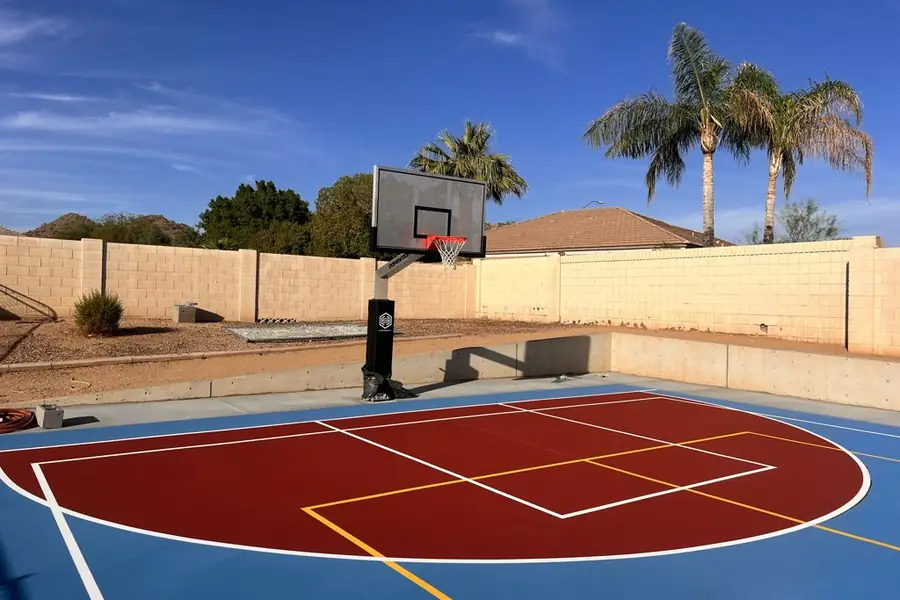
Basketball court installation runs from a backyard half court to a full court, and a multi-sport court lines one slab for several games. More on basketball courts and multi-sport courts.
Bocce and padel courts
Apex installs bocce courts and resurfaces or rebuilds worn ones, quoted after a visit, and builds padel courts. More on bocce court installation and padel courts.
Court resurfacing in Chandler
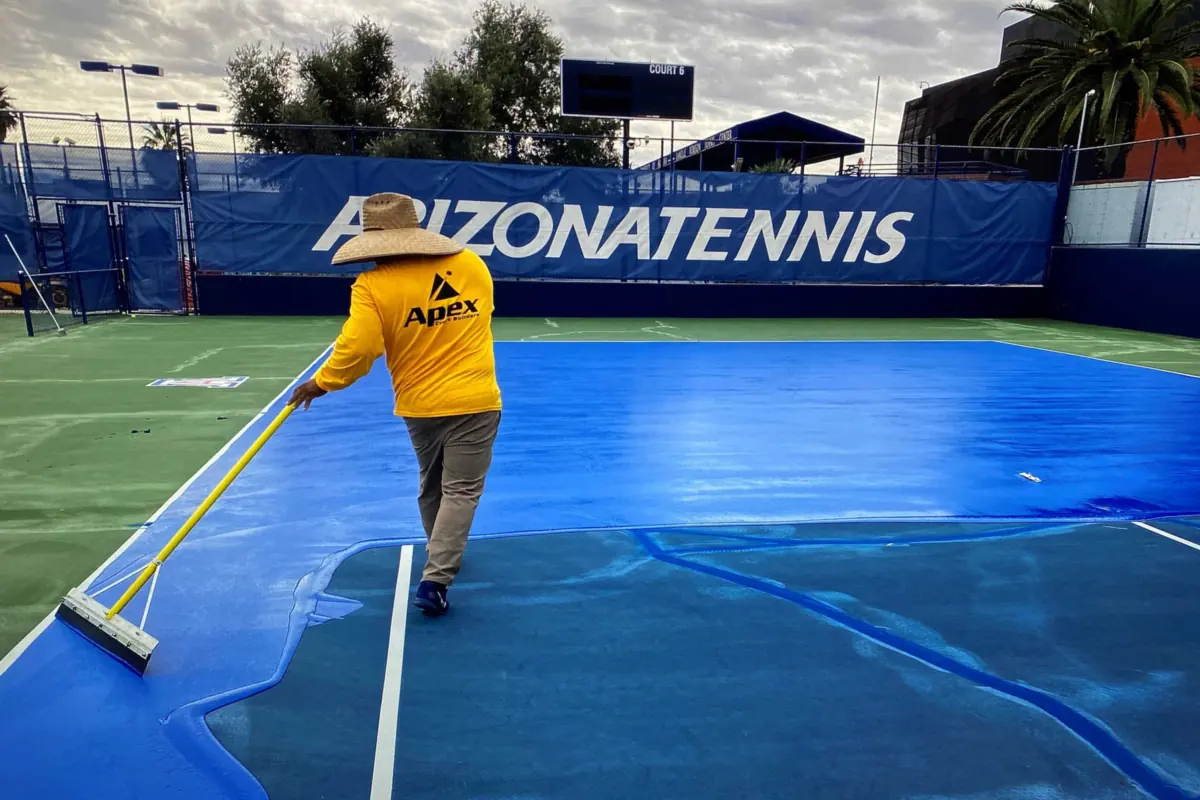
A recoat runs cleaning and crack repair, leveling, an acrylic resurfacer, color coats, and lines for each game the court hosts, in that order. On expansive clay a slab can heave and crack, and heat and UV wear an acrylic coat down, so color fades and cracks open sooner than in a milder climate.
Apex resurfaces backyard, association and club courts, and a sound tennis court can take up to four pickleball courts without a new slab. More on court resurfacing and repairs.
| Services | Court construction, court resurfacing and tennis to pickleball conversions |
|---|---|
| Areas served | Chandler and Sun Lakes. Other cities are on the service area page. |
| Based in | 705 E. Granada Road, Phoenix, AZ 85006 |
| Hours | Monday to Friday, 7:00 AM to 5:00 PM Arizona time |
| Phone | (480) 264-6889 |
| License | Arizona ROC 324026, class KA Dual Engineering, held by Apex Courts Arizona LLC, licensed since 2019 |
Court questions
What rules apply to court lights in Chandler?
How tall can a court fence be?
Does the court slab need a building permit?
Does a court change my lot’s drainage plan?
When in the year can a court be coated?
How far is Chandler from Apex?
Request a free estimate
Every court is quoted per project, and final pricing depends on court size, existing surface condition, crack repair, drainage and low spots, coating system, colors, striping and site access. Tell us where the court is going, whether you want lights and whether the lot retains its own stormwater. Call (480) 264-6889 and the owner answers. The consultation is free. Or send the form below and we call you back.