Court Builder in Queen Creek, AZ
Apex Courts Arizona LLC, ROC 324026, class KA Dual Engineering, licensed since 2019, 800+ courts built across Arizona, family owned in Phoenix, ASBA member, BBB Accredited.
The family behind Apex Court Builders works out of Phoenix and builds pickleball, basketball, tennis and multi-sport courts in Queen Creek, for a single backyard or an HOA, club or school, and resurfaces worn ones. Arizona ROC 324026, held by Apex Courts Arizona LLC, is one license that covers commercial and residential work, grading and concrete included, and court lighting is on the same contract.
Call (480) 264-6889, Monday to Friday 7:00 AM to 5:00 PM Arizona time, or request a free estimate.
Fences, slabs and permits
Section 6.1.F of Queen Creek’s zoning ordinance lets a private tennis court, where allowed as an accessory use, sit as near as 10 feet to its side and rear lot lines, with a fence or wall up to 12 feet, or 6 feet within a side or rear setback. A fence over 6 feet needs a design by an Arizona registered structural engineer and the Town’s approval, and over 7 feet a building permit, so a court fence of 10 feet needs both.
Under the ordinance a fence is any manmade barrier other than a retaining wall, whatever its material, and chain link is barred in every zoning district. Whether 6.1.F, written for tennis, also governs pickleball, basketball and multi-sport courts, and whether any chain link court enclosure can be approved, are the Town’s to answer in writing before a fence is quoted.
The Town’s permit exemptions cover sidewalks and driveways without naming a court slab, so whether a slab needs a permit is Building Safety’s call. Anyone doing business in town needs a Town business license before the work begins.
Court lights and the neighbors
Section 5.5 limits outdoor light to protect what it calls the rural atmosphere and astronomical observations. A fixture over 1,800 lumens, or a flood or spot light over 900, may send no direct light above horizontal or mount higher than 25 feet, with a lower cap near a property line.
At a residential lot line, court lights may add 1.0 footcandle at most. For recreational facilities, public or private, the ordinance allows no court lighting after 11 PM, and 6.1.F requires tennis court lights to be shielded from adjoining properties.
HOA design review
Ironwood Crossing, in town on the Pinal County side, binds every owner to design guidelines last revised June 23, 2020. Lights there may not pass an intensity of one foot candlepower measured from the lot line or a height of 12 feet, and concrete beyond the walk from the driveway to the rear gate needs written approval, so a lit court goes to the Design Review Committee for its slab, fence and poles.
Soil and the coating calendar
The Town flood irrigates about 500 homes year round, twice a month in summer and once in winter, and owners keep the water inside bermed, laser leveled yards. On those lots the court has to sit outside the flooded basin or above its waterline, so whether a lot takes Town irrigation is the first question for a layout.
At four points in and near town, USDA soil data reads well drained sandy and loamy stream deposits with a linear extensibility, a shrink and swell measure, of 1.5 percent at most, inside the low shrink and swell class that the NRCS handbook sets below 3 percent. A point toward the San Tan Mountains reads rock land, so post holes there can hit rock. Earth fissures tied to groundwater pumping are mapped near town, and heavy rain reopened a 1.5 mile one nearby in August 2005, so check the Arizona Geological Survey maps for the lot.
Chandler Heights, the nearest station with temperature normals, averages 94.8 days of 100°F or more a year and 145 nights at or under 50°F. One maker’s data sheet sets a floor of 50°F and rising for both air and surface and rules out rain and any surface over 140°F, and another needs both above 50°F during and for 24 hours after a coat. In a study of Phoenix streets NASA says asphalt can run 40 to 60°F hotter than the air on a very hot day, so in summer the 140°F cap favors coating soon after sunrise. November through March bring 22 to 29 such nights a month, leaving the 24-hour product few winter windows.
Courts we build
Pickleball courts
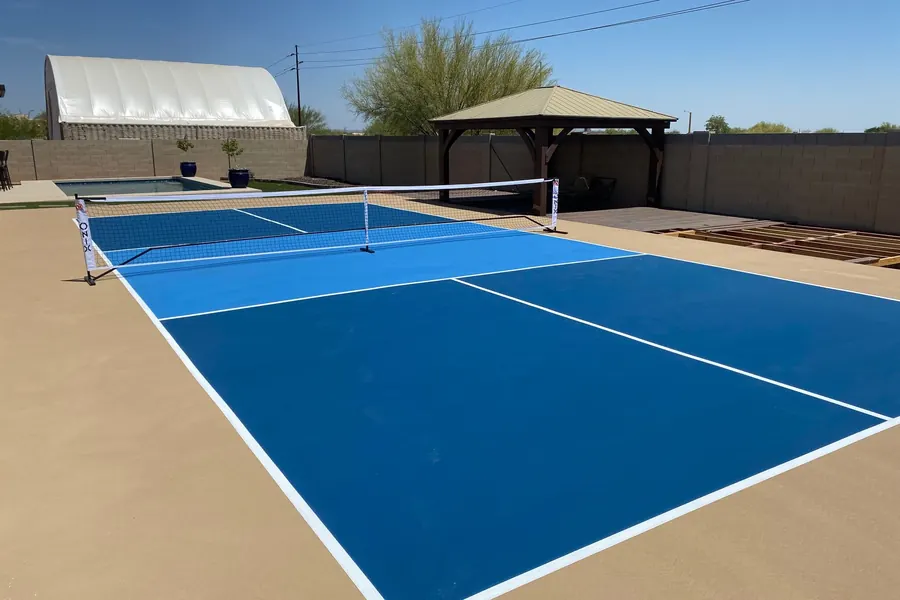
Each pickleball court goes down as a concrete slab, then takes its acrylic color, lines and net.
Tennis courts
A tennis court at regulation size, run-off counted, needs a pad roughly 120 feet long by 60 wide, and pickleball lines can share the slab in a second color.
Basketball and multi-sport courts
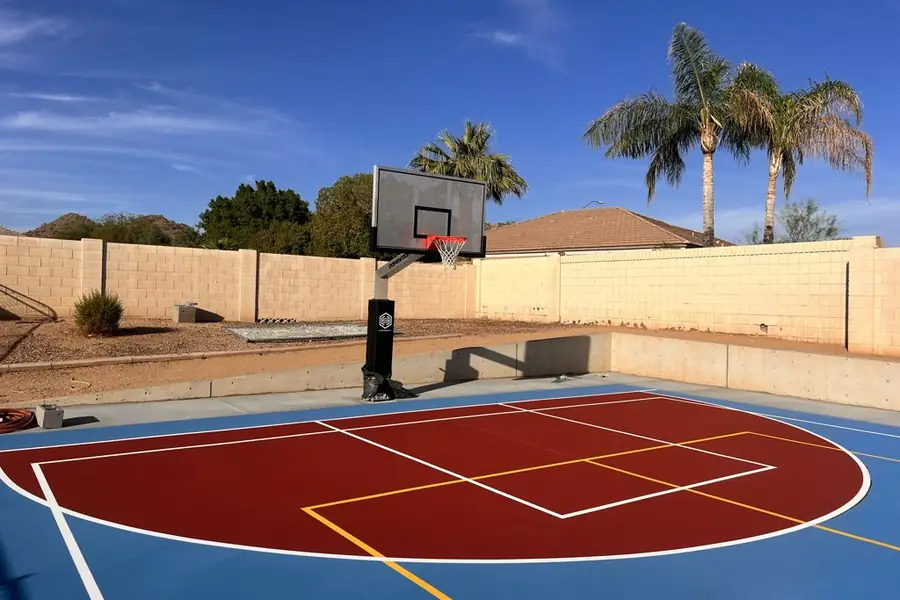
For basketball, Apex builds a full court or a half court, and a multi-sport court shares one slab among several games.
Apex takes on bocce and padel courts too.
Court resurfacing in Queen Creek
A resurface cleans the court, fills its cracks and levels its low spots, then a coat of acrylic resurfacer evens it out ahead of the color coats and lines for each game on it. Desert sun and heat fade acrylic color and open cracks earlier than a milder climate does. Apex inspects the slab before quoting, and on a flood irrigated lot the edge beside the bermed basin deserves a close look. A sound tennis court relined for pickleball holds four courts at most on its existing slab.
| Services | Court building and resurfacing |
|---|---|
| Areas served | Queen Creek. The service area page lists the other cities. |
| Based in | 705 E. Granada Road, Phoenix, AZ 85006 |
| Hours | Monday to Friday, 7:00 AM to 5:00 PM Arizona time |
| Phone | (480) 264-6889 |
| License | Arizona ROC 324026, class KA Dual Engineering, held by Apex Courts Arizona LLC, licensed since 2019 |
Court questions
How high can the fence around a court go?
What do the lighting rules ask of court lights?
Does an HOA have to approve a court?
Does a court slab need a permit?
What happens at the site visit?
Request a free estimate
Every court is quoted per project, and final pricing depends on court size, existing surface condition, crack repair, drainage and low spots, coating system, colors, striping and site access. Tell us whether you want lights, whether the yard takes Town irrigation and whether an HOA reviews it. Call (480) 264-6889 and the owner answers. The consultation is free. Or send the form below and we call you back.