Court Construction in Surprise, AZ
Apex Courts Arizona LLC, ROC 324026, class KA Dual Engineering, licensed since 2019, 800+ courts built across Arizona, family owned in Phoenix, ASBA member, BBB Accredited.
Apex Court Builders is a family owned company in Phoenix that builds and resurfaces courts in Surprise, for pickleball, tennis, basketball or several games on one multi-sport slab. It works under Arizona ROC 324026, one license that covers commercial and residential work, grading and concrete included. Court lighting is on the same contract.
Call (480) 264-6889, Monday to Friday 7:00 AM to 5:00 PM Arizona time, or request a free estimate.
Fences, slabs and permits
Surprise’s zoning code gives the backyard court its own standard, section 106-10.44, enclosure and lights included. No court at a home may sit in the front yard, and an unlit one keeps 5 feet from every lot line and inside the accessory height limit, 9 feet at the 5-foot setback line and rising with distance to 15 feet.
A residential fence tops out at 6 feet. Chain link is barred except at public facilities and recreational uses such as a court enclosure, which the fence standard lets go taller. No fence exemption in the building code reaches 10 feet, so a court enclosure that tall needs a building permit.
The Building Official decides whether a slab needs a permit. A single lot of one acre or less is excused from on-site stormwater retention. The city also requires a license to carry on business inside its limits, with an exemption for an outside firm whose only contact there is delivering goods ordered ahead.
Court lights and the neighbors
The city’s 2023 lighting article keeps direct light inside the property and, with a few exceptions, requires full cut-off fixtures, underground service and adaptive controls. Its rules for lit courts add these limits.
- A lit court sits at least 20 feet from side and rear lot lines, with zero foot-candles along every property line.
- Lights go off at the lot’s lighting zone curfew, 11 PM at the latest, except to finish a scheduled event delayed by unusual circumstances.
- Mounting heights should stay within 25 feet over basketball or tennis, 20 over bocce.
- LED lamps run 3,000K or lower, and full cut-off can be waived on an engineer’s certificate the city accepts.
An approved photometric plan comes before the building permit. The court section is titled for school and community facilities, so whether it binds a backyard court is a question for city Planning.
Community rules and HOA review
Sun City Grand, inside the city, requires its architectural review committee’s approval before any exterior improvement, and its May 2026 Residential Design Guidelines bar chain-link fencing and cap wall, patio cover and column fixtures at 800 lumens at most.
Sun City West is unincorporated, so Maricopa County’s zoning ordinance, light rules included, governs a court there in place of the city’s, and a fence taller than 6 feet needs the county’s Zoning Clearance. Its Recreation Centers count more than 100 sets of covenants and make each owner responsible for knowing the lot’s set.
Soil and the coating calendar
The USDA soil survey maps City Hall and the city’s Tennis and Racquet Complex on Gilman loam, a well drained soil laid down by streams, and none of seven points sampled across the area lists a restrictive layer, so fence post and light pole holes there should dig as soil, not rock. Two of the points carry up to about 30 percent clay that swells more when wet, and drainage away from the slab matters most there.
Coating makers want the air and the court surface at 50°F or above with no rain imminent, and one stops work once the surface passes 140°F. NOAA’s Youngtown station, about 4.5 miles from City Hall, reaches 100°F on 115 days in a normal year, and NASA says dark street paving can run 40 to 60°F above the air on very hot days, so summer coats lean toward early morning.
From November through March, Youngtown logs 16 to 28 nights a month at 50°F or below, so winter coats wait for the day’s warmth. NOAA’s Wittmann station, about 14 miles northwest of City Hall, logs 14 such nights in a normal April against Youngtown’s 5, so the spring and fall windows likely run shorter toward the city’s north end.
Courts we build
Pickleball courts
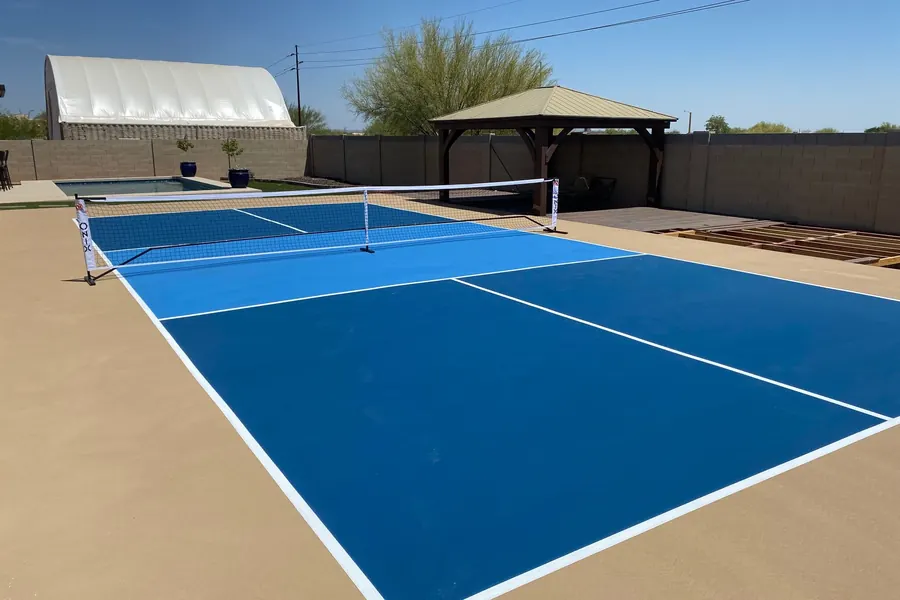
Apex builds a backyard pickleball court for one household or a bank of courts for a club or an HOA, each a concrete slab topped with acrylic color coats.
Tennis courts
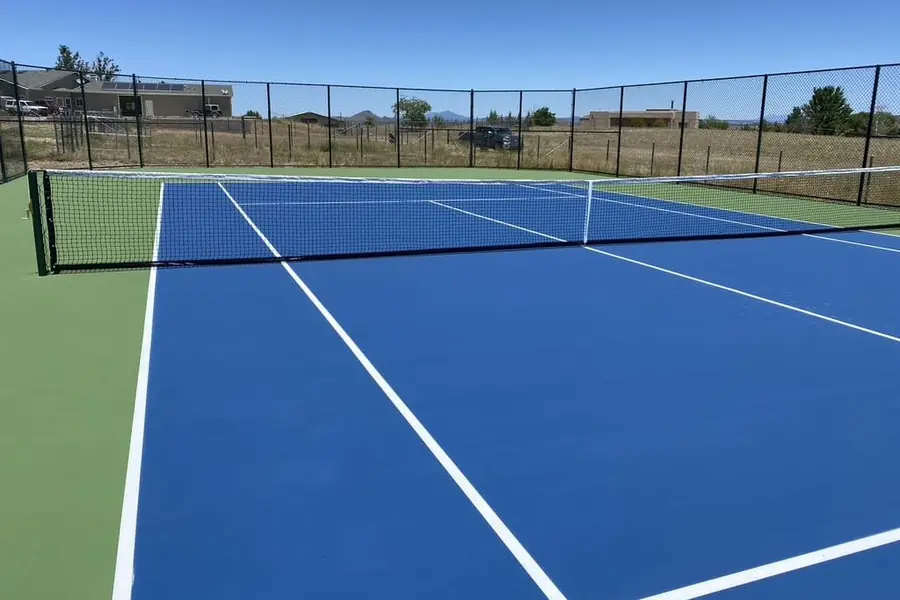
A regulation tennis court and its run-off take a pad about 60 feet wide and 120 long. A practice layout suits a shorter lot, and a second line color lets pickleball share the slab.
Basketball and multi-sport courts
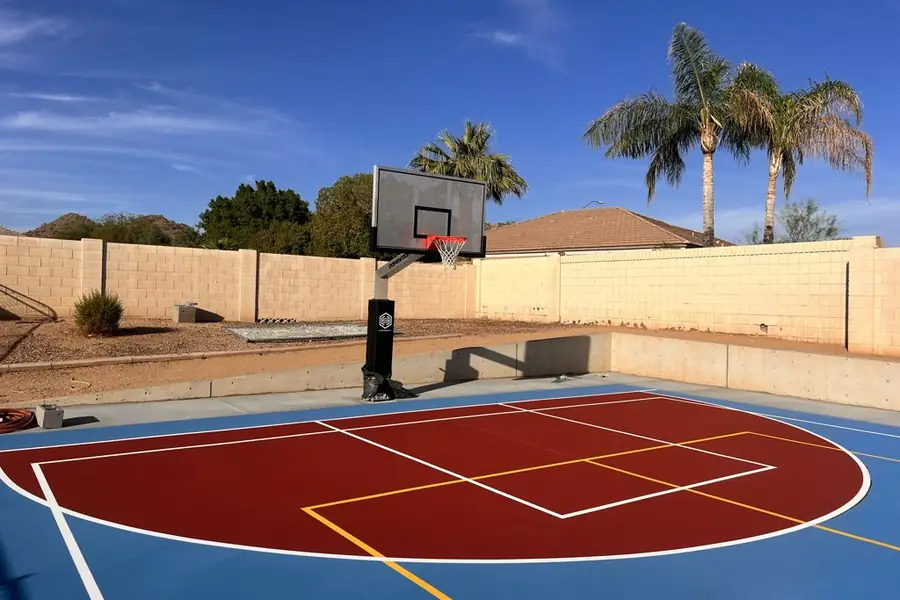
A basketball court can run half or full length, and a multi-sport court marks one surface for basketball, pickleball and more.
Court resurfacing in Surprise
Apex resurfaces a court once its color has faded or its surface has cracked, working from a cleaning through crack filling, leveling, an acrylic resurfacer and color coats to new lines for every game played there. Heat and sun fade acrylic and open cracks earlier than they do where summers are mild, and monsoon water finds any crack left unfilled.
A tennis court with a sound slab can be recoated and relined as up to four pickleball courts without new concrete.
| Services | New courts, resurfacing, and tennis courts converted for pickleball |
|---|---|
| Areas served | Surprise and Sun City West. The service area page lists more cities. |
| Based in | 705 E. Granada Road, Phoenix, AZ 85006 |
| Hours | Monday to Friday, 7:00 AM to 5:00 PM Arizona time |
| Phone | (480) 264-6889 |
| License | Arizona ROC 324026, class KA Dual Engineering, held by Apex Courts Arizona LLC, licensed since 2019 |
Court questions
How tall can a court enclosure be?
When do court lights have to go off?
Does an HOA have to approve a court first?
Is a building permit needed for the slab?
How far is the drive for a site visit?
Request a free estimate
Every court is quoted per project, and final pricing depends on court size, existing surface condition, crack repair, drainage and low spots, coating system, colors, striping and site access. Tell us where the court is going, whether you want lights and whether an HOA reviews the design. Call (480) 264-6889 and the owner answers. The consultation is free. Or send the form below and we call you back.