
Court Builder in San Tan Valley, AZ
Apex Courts Arizona LLC, ROC 324026, class KA Dual Engineering, licensed since 2019, 800+ courts built across Arizona, family owned in Phoenix, ASBA member, BBB Accredited.
Apex Court Builders, a family company working out of Phoenix, builds pickleball, tennis, basketball and multi-sport courts for San Tan Valley homeowners and HOAs, and resurfaces worn ones. Apex Courts Arizona LLC holds Arizona ROC 324026, one license that covers commercial and residential work, grading and concrete included, and court lighting is on the same contract.
Call (480) 264-6889, Monday to Friday 7:00 AM to 5:00 PM Arizona time, or request a free estimate.
Town limits or county land
San Tan Valley incorporated in 2025 and took zoning and development review over from Pinal County on July 1, 2026. Inside town limits a court now meets the town’s Zoning Ordinance and a building code built on the 2024 ICC codes. Floodplain management stayed with the Pinal County Flood Control District, and areas the county approved as Planned Area Developments keep those standards as an overlay.
The town covers about 34.6 square miles of land, under half the 75.8 the 2020 census counted for San Tan Valley, so many homes with a San Tan Valley address sit on unincorporated land under Pinal County’s code. The site visit settles which side of the line a lot is on.
Court lights after dark
The town’s lighting rules exist partly to protect astronomical observation and the low light of its rural areas. Court lighting escapes the rest of those rules, the 10,000 lumen cap on a single family parcel included, only if it is designed to IESNA illuminance targets, shielded and aimed to limit skyglow and light trespass, and fully off within one hour of the end of play or 10 PM, whichever is later. Poles over 20 feet are prohibited except for recreational fields.
Whether the town reads a backyard court under that rule, and whether the pole exception reaches a court, are for Planning and Zoning to answer. On county land, home court lights go off whenever the court is not in use.
Fences and town permits
In the town’s residential districts, a fence or wall in or along a required side or rear yard stops at 6 feet, and chain link is allowed only where it cannot be seen from off site. A wall or fence over 7 feet needs a building permit and plans by an Arizona registered structural engineer, so a 10-foot court enclosure needs both. Planning and Zoning answers whether one may stand farther into the lot and whether vinyl coated chain link counts.
Town Code 16-8 bars any fence or wall that blocks or slows an upstream neighbor’s historic runoff. Town Code 9-1-1 makes it unlawful to carry on a business in town without a town business license, and a Phoenix contractor is no exception.
Johnson Ranch design review
Johnson Ranch’s Design Review Guidelines, dated September 23, 2025, require the committee’s written approval before any change to a lot or home exterior, take the application from the owner of record and never from a contractor, and prohibit lights for night use of basketball goals. They name no tennis or pickleball court, so ask the committee whether one is allowed.
Clay, lime and fissures
USDA soil data puts Contine clay loam under the town office area on Schnepf Road, about 45 percent clay from about 1 to 3 feet down, with a linear extensibility of 7.5 percent, the soil survey’s gauge of shrinking and swelling. Mohall loam near the middle of town carries lime layers from about 2 feet down, though the survey lists no restrictive layer there. The Arizona Geological Survey’s fissure data, last updated in 2015, shows earth fissures inside the town’s west edge. FEMA maps the Queen Creek channel in town as Zone A, where a county floodplain use permit comes before construction.
Cold nights, hot slabs
From November through March, normal lows at Chandler Heights, the closest station with federal temperature normals, about 8 miles west, run from 39°F to 48°F, under the 50°F that coating data sheets set for air and surface, and one product needs 50°F held for 24 hours after it goes on. Normal highs there pass 102°F in June, July and August, and one maker allows no coat on a surface above 140°F, so the surface cap favors early starts in summer. At Florence, about half the yearly rain falls from December through March, so winter coats wait on the forecast as well.
New courts
Pickleball courts
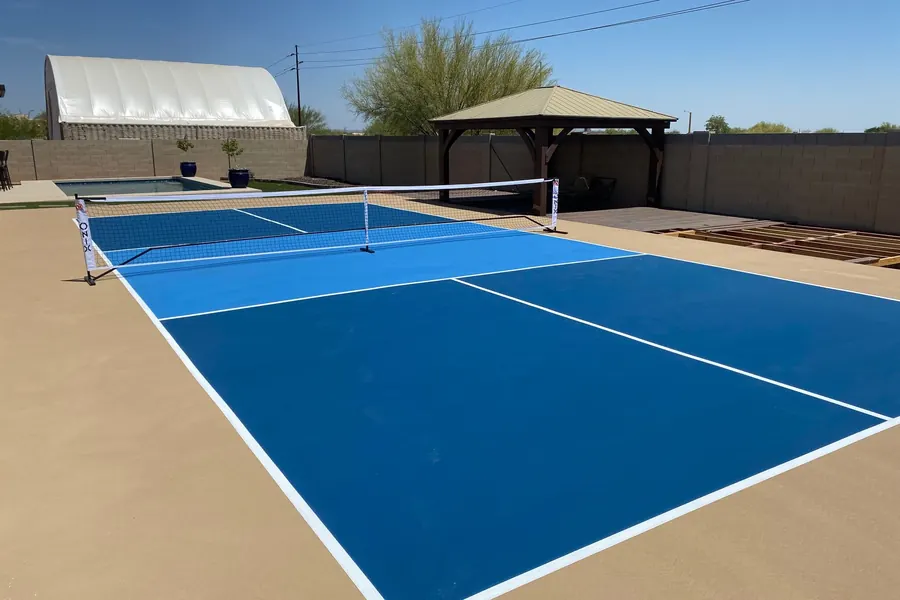
A pickleball court for one yard, or a group of them for an HOA, starts as a concrete slab that cures before the acrylic color coats and lines go on.
Tennis courts
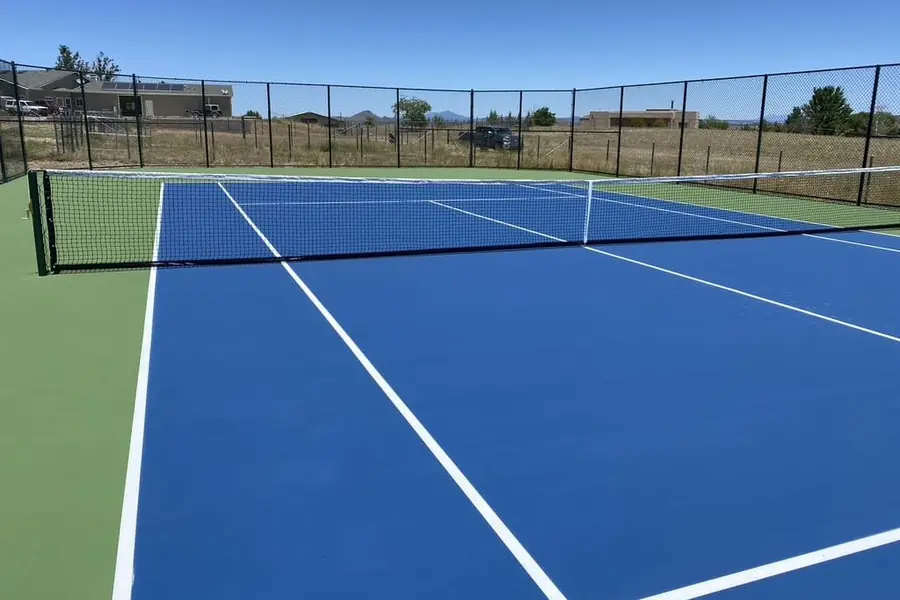
Run-off included, a regulation tennis court needs about 60 by 120 feet, and a smaller practice court suits a tighter lot.
Basketball and other games
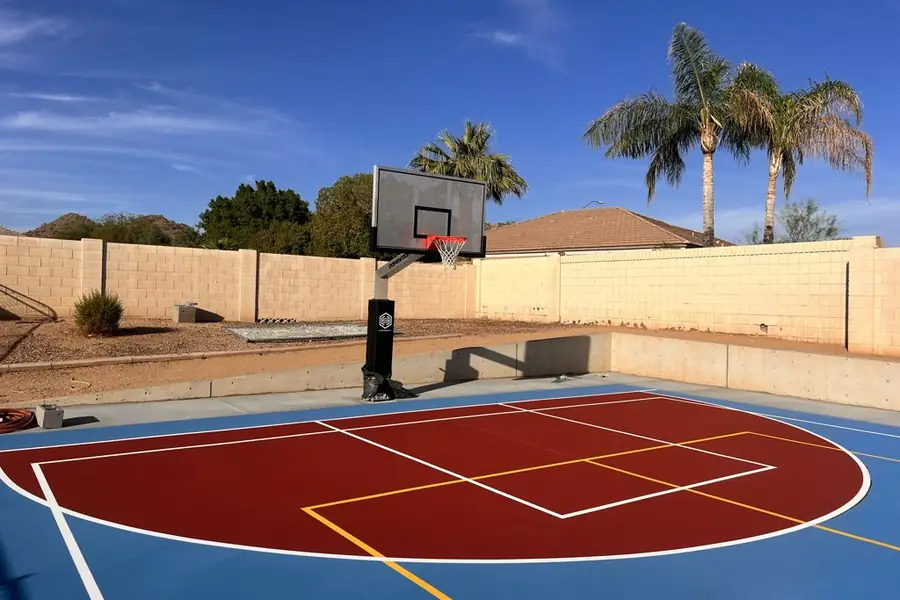
A basketball court can stop at one key as a half court or run the full length, and a multi-sport court marks out more than one game on the same concrete. Bocce and padel courts are built too.
Court resurfacing in San Tan Valley
Cleaning comes first in a resurface, then crack filling and leveling of birdbaths, the low spots that hold water. Acrylic resurfacer follows to smooth the texture, then new color coats and the lines for every game the court hosts. The coating limits above hold for a recoat too. Where a tennis court’s slab is still sound, it can be relined for pickleball, up to four courts in one tennis footprint.
| Services | Court building and resurfacing |
|---|---|
| Areas served | San Tan Valley, in town limits and on county land. More cities are on the service area page. |
| Based in | 705 E. Granada Road, Phoenix, AZ 85006 |
| Hours | Monday to Friday, 7:00 AM to 5:00 PM Arizona time |
| Phone | (480) 264-6889 |
| License | Arizona ROC 324026, class KA Dual Engineering, held by Apex Courts Arizona LLC, licensed since 2019 |
Court questions
Do town rules or county rules apply to my lot?
How tall can a court fence be, and when does it need a permit?
When do court lights have to be off?
Which drainage and slab rules reach a backyard court?
What happens before the quote?
Request a free estimate
Every court is quoted per project, and final pricing depends on court size, existing surface condition, crack repair, drainage and low spots, coating system, colors, striping and site access. Send the address so we can check whether the lot is inside town limits, and tell us whether you want lights and whether an HOA reviews the plans. Call (480) 264-6889 and the owner answers. The consultation is free. Or send the form below and we call you back.