Court Contractor in Buckeye, AZ
Apex Courts Arizona LLC, ROC 324026, class KA Dual Engineering, licensed since 2019, 800+ courts built across Arizona, family owned in Phoenix, ASBA member, BBB Accredited.
In Buckeye, Apex Court Builders builds multi-sport courts and dedicated pickleball, tennis and basketball courts, and gives worn courts a new surface. The family owned company works from Phoenix under Arizona ROC 324026, one license that covers commercial and residential work, grading and concrete included, and court lighting is on the same contract.
Call (480) 264-6889, Monday to Friday 7:00 AM to 5:00 PM Arizona time, or request a free estimate.
Court fences and building permits
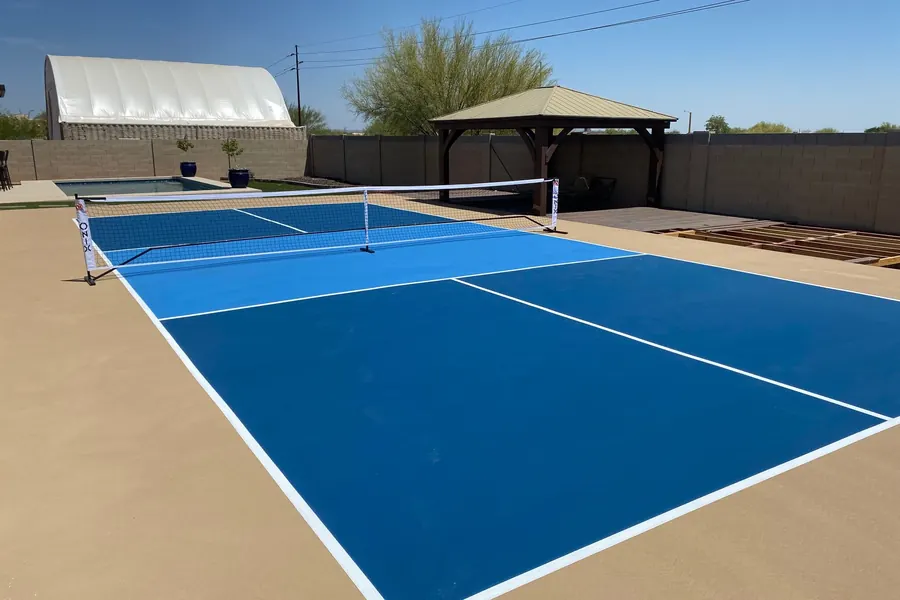
On a home lot, Buckeye’s Development Code caps a fence between the house and a side or rear lot line at 6 feet, and it bans chain link on home and commercial sites except to enclose a court or protect the public during approved construction. The amended building code exempts a residential fence from a permit only to 7 feet, so a 10-foot court enclosure takes a building permit.
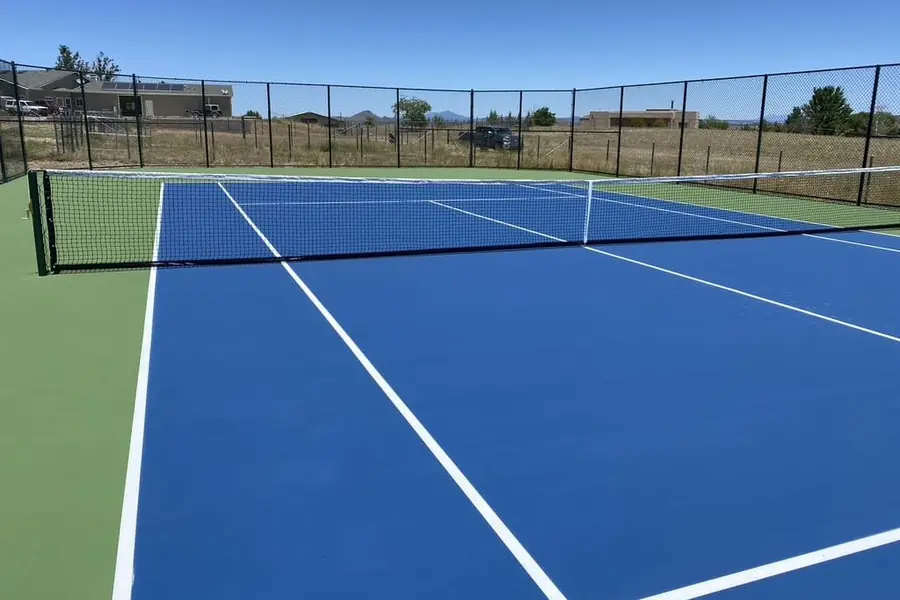
Zoning can be read two ways. As a fence, the enclosure runs into the 6-foot cap. As an accessory structure behind the house, it keeps 3 feet from any property line, or 5 feet if taller than 10 feet. Ask Planning in writing which one applies.
On a lot where the ground to be disturbed slopes 15 percent or more, as a registered engineer determines, the hillside standards limit fences, retaining walls aside, to privacy fences attached to the house or screening part of it.
Court lights under the Development Code
The Development Code names tennis courts among the outdoor recreational uses whose lighting it exempts from its general rules if three limits hold. The lights are out by 11 PM, the property line gets no more than 2 footcandles, and no light post passes 80 feet. Ordinary home fixtures are held tighter. One of 1,000 lumens or more must be fully shielded, light may add no more than 1 footcandle beyond the lot, and color temperature stays at 3,000K or below. Whether a backyard court counts as a recreational use is Planning’s call, best asked in writing.
Community guidelines that come first
Section 4.92 of Verrado’s Residential Design Guidelines, revised in April 2026, allows no tennis or pickleball court on any residential lot and no court lighting on one either. Other game courts are refused unless the Design Review Committee approves one case by case, at its sole discretion. A bocce court or a permanent basketball goal needs the committee’s approval first, and chain link fencing is prohibited on any lot unless the committee specifically approves it. Where a city standard and the guidelines differ, the stricter provision governs.
Floodplains and soil
On a lot in a mapped floodplain, the Flood Control District of Maricopa County’s floodplain use permit, required even for fencing or grading, comes before any city permit. FEMA’s maps place the Gila River south of downtown in their special flood hazard area and show a floodway on the Hassayampa.
At a sample point in the White Tank foothills, the USDA’s soil survey shows Ebon soil turning to very cobbly clay, about half clay, from roughly 13 inches down. Clay like that swells with water, which the Arizona Geological Survey says can lift and crack slabs, so drainage away from a court matters there and post holes are likely to hit cobbles. At two other sample points, Coolidge and Pinamt soils hold calcium carbonate, the lime that cements soil into caliche, from the surface or just below it, though the survey lists no cemented layer at either point.
The coating calendar
Coating makers set a floor of 50°F for air and surface alike, with no rain due, and one halts work on a surface above 140°F. Litchfield Park’s NOAA record stands in for Buckeye’s missing normals, with air at 100°F or more on 112 days of a normal year. On a June day in 2024 when Phoenix air reached 106°F, NASA read asphalt and concrete surfaces there at 120°F or more to the touch, the hottest near 140°F, so in summer that 140°F limit favors coating early in the morning.
From November through March, 17 to 29 nights a month drop to 50°F or lower in that record, too cold for a product that must stay above 50°F for 24 hours after it goes down. The Wittmann station, at about the height of the city’s north end, counts 14 such nights in April against Litchfield Park’s 6, so the spring coating window opens later up there.
Game courts Apex builds
Multi-sport courts
A multi-sport court gives basketball, pickleball and volleyball one shared slab of acrylic coated concrete.
Pickleball courts
For pickleball, Apex builds one backyard court or a set of courts for a club or homeowners association, its standard court on the 34 by 64 feet USA Pickleball recommends for new construction.
Tennis courts
Tennis needs roughly 60 by 120 feet for a regulation court with run-off, or less for a practice layout.
Basketball courts
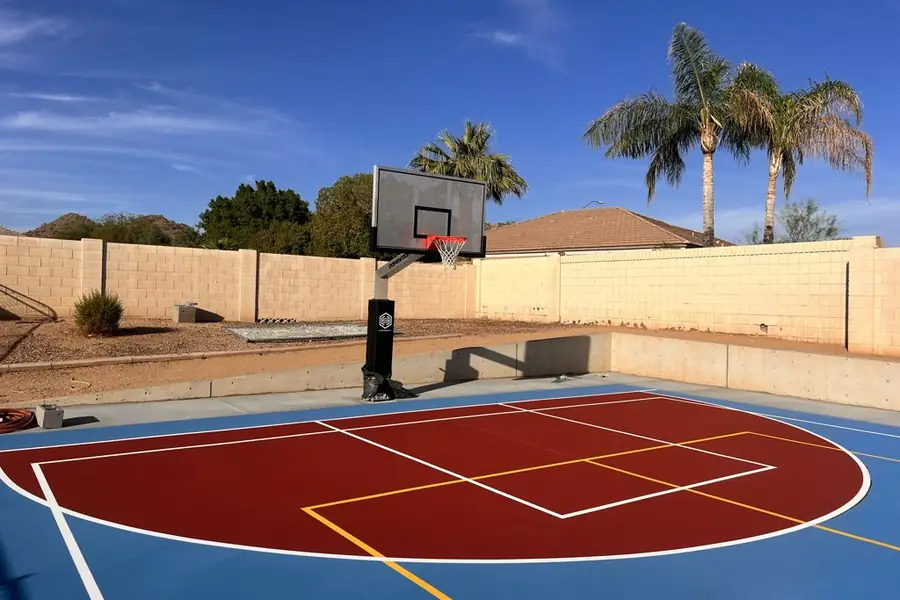
Basketball courts go in at full length or as half courts sized to the yard.
Court resurfacing in Buckeye
A court resurface begins with the court cleaned and its cracks filled. Low spots are patched level, a coat of acrylic resurfacer evens out the texture, and color coats go down before each game gets its lines. Arizona sun and heat wear acrylic down sooner than milder weather would. Pickleball can take over a tennis court whose slab is sound, with room for four pickleball courts at the most and no new concrete poured.
| Services | Multi-sport and single game courts built new, worn courts resurfaced, tennis courts relined for pickleball |
|---|---|
| Areas served | Buckeye. Our service area page lists other Arizona cities. |
| Based in | 705 E. Granada Road, Phoenix, AZ 85006 |
| Hours | Monday to Friday, 7:00 AM to 5:00 PM Arizona time |
| Phone | (480) 264-6889 |
| License | Arizona ROC 324026, class KA Dual Engineering, held by Apex Courts Arizona LLC, licensed since 2019 |
Court questions
What height can a court fence reach?
When do the court lights have to be off?
Which permits come before the slab is poured?
Can you use a tennis court as a pickleball court?
What happens at the site visit?
Request a free estimate
Every court is quoted per project, and final pricing depends on court size, existing surface condition, crack repair, drainage and low spots, coating system, colors, striping and site access. Tell us where the court is going, whether you want lights and whether the lot sits in a master-planned community or a floodplain. Call (480) 264-6889 and the owner answers. The consultation is free. Or send the form below and we call you back.