
Court Builder in Prescott, AZ
Apex Courts Arizona LLC, ROC 324026, class KA Dual Engineering, licensed since 2019, 800+ courts built across Arizona, family owned in Phoenix, ASBA member, BBB Accredited.
Apex Court Builders, run by a Phoenix family, builds new courts and resurfaces old ones in Prescott and Prescott Valley, for basketball, pickleball, tennis and multi-sport play. Its courts go in under Arizona ROC 324026, one license that covers commercial and residential work, grading and concrete included, and court lighting is on the same contract. Freezing nights, lighting codes and town fence limits all shape a court plan here.
Call (480) 264-6889, Monday to Friday 7:00 AM to 5:00 PM Arizona time, or request a free estimate.
Freezing nights and the coating season
One coating maker lets work begin once the air and the court surface reach 50°F and are still warming. A second maker’s resurfacer and color coating need both above 50°F as they go down and for at least the next 24 hours. Both makers say to keep their products from freezing.
At Love Field, Prescott’s airport weather station, the 1991 to 2020 normals count 113 nights a year at or below 32°F, while a day that never climbs above freezing comes about once in two years. The normal low tops 50°F only from June through September, so those are the only months when the air on a normal night stays above the second maker’s 50°F minimum.
From early July the National Weather Service expects monsoon thunderstorms on most afternoons and evenings in northern Arizona, and both makers rule out coating with rain expected.
Frost, rock and graded pads
The frost line in Prescott’s residential code table is 18 inches deep. Ask the Permit Center whether the posts of a 10-foot court fence and the bases of light poles must reach below it.
The Arizona Geological Survey describes coarse-grained granite exposed in the Granite Dells just north of the city, and the city’s code says the hills around it have steep slopes that may contain unstable rock. The code’s grading rules reach work that disturbs, grades or places more than 50 cubic yards and require stabilization for any cut or fill slope 2 feet or higher. How much a court pad cuts and fills depends on the lot’s grade, which the site visit checks.
How tall a court fence can be
In Prescott, a fence or wall over 4 feet needs a permit, and fences stop at 6 feet in a required side or rear yard and 4 feet in a required front yard. Whether a 10-foot court enclosure outside those yards is held to 6 feet as a fence or treated as an accessory structure is a question to put to Planning and Zoning in writing.
Prescott Valley requires a zoning permit for any fence 3 feet or taller and caps residential fences at 6 feet in side and rear yards, 4 in front. Ask the town whether a 10-foot court enclosure needs a variance from its Board of Adjustment and whether windscreens count as the fabric mesh it bans on residential fences. Its building permit exemption for flatwork ends at 200 square feet, so ask about the court slab too.
Chino Valley’s code lets no wall or fence in a residential or agricultural district exceed 6 feet, or 5 feet in a required front yard.
Court lights under three codes
Prescott’s Land Development Code brings court lighting at a house under its lighting rules by name. Fixtures must be cut-off. A pole within 50 feet of a property line bordering residential zoning stops at 18 feet, and light at a property line next to residential areas averages no more than 0.5 foot-candle at grade. Outdoor lighting must be off between 10 PM and sunrise, and only public or municipal recreation lighting may stay on past 11 PM to finish play.
Prescott Valley’s lighting article reaches a single family home on its own lot. Every fixture must be fully shielded unless exempted, a residential fixture sits no higher than 12 feet above the grade beside it, and light at an adjoining residential property line stays at or under 0.25 foot-candle, measured 6 feet up. Ask the town whether that 12-foot cap applies to court poles.
On unincorporated Yavapai County land, a single family lot gets 5,000 lumens in all. An outdoor recreation facility may exceed the per acre limit in the county’s light output table if the Development Services Director approves, and its lights are designed and certified by an engineer and off by 10 PM. Ask the county whether a backyard court counts as one and which limit then applies.
Game courts we build
Pickleball courts
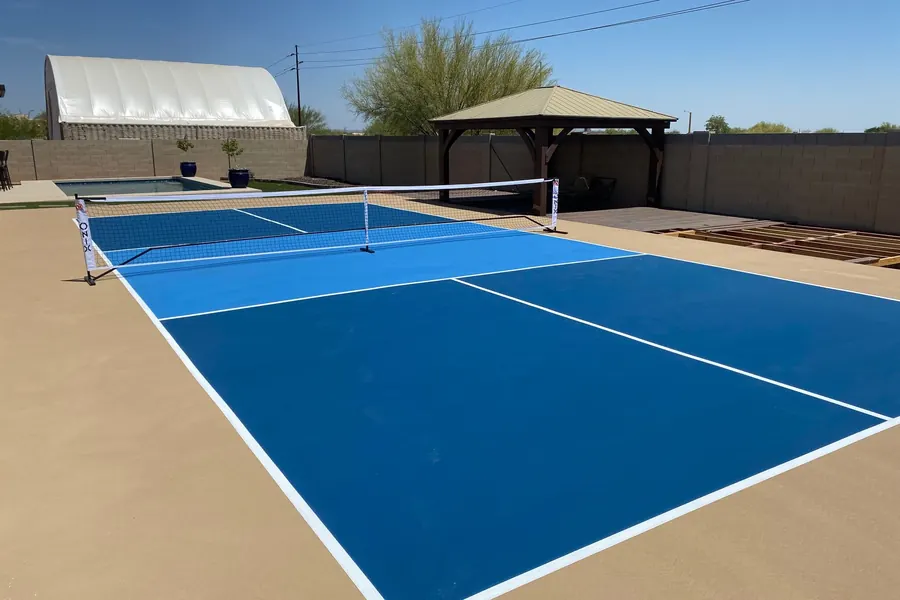
Apex builds pickleball courts for homeowners, HOAs and clubs, one court or several side by side, each poured in concrete and colored with acrylic coats.
Tennis courts
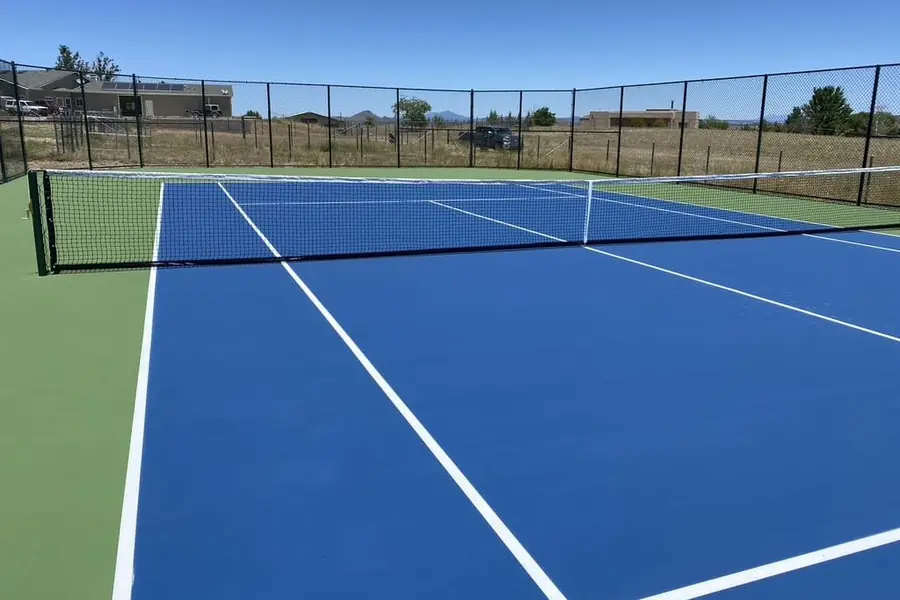
Tennis at regulation size takes a pad of roughly 60 by 120 feet once the run-off beyond the lines is included, and a smaller practice court is an option on a tight site.
Basketball and multi-sport courts
A basketball court can be built at half size or full size, and a multi-sport court stripes one slab for basketball, pickleball and other games. Apex builds padel and bocce courts as well.
Court resurfacing in Prescott
Resurfacing an existing court starts with cleaning, then crack filling and leveling of low spots, an acrylic resurfacer to even the texture, color coats and fresh lines. A recoat is held to the same temperature and rain limits as a new court. Cracks tend to grow from one season to the next. A tennis court on a sound slab can take four pickleball courts at most, with no new concrete.
| Services | New courts, resurfacing and tennis courts converted for pickleball |
|---|---|
| Areas served | Prescott and Prescott Valley. Apex works across Arizona, and the service area page lists its other city pages. |
| Based in | 705 E. Granada Road, Phoenix, AZ 85006 |
| Hours | Monday to Friday, 7:00 AM to 5:00 PM Arizona time |
| Phone | (480) 264-6889 |
| License | Arizona ROC 324026, class KA Dual Engineering, held by Apex Courts Arizona LLC, licensed since 2019 |
Court questions
Which months work for coating a court here?
What do frost and a sloped lot change?
What changes for a court in Prescott Valley?
What do the lighting codes allow on a home court?
What comes before a written quote?
Request a free estimate
Every court is quoted per project, and final pricing depends on court size, existing surface condition, crack repair, drainage and low spots, coating system, colors, striping and site access. Tell us where the court is going, whether the lot sits in Prescott, Prescott Valley or county land, and how much it slopes. Call (480) 264-6889 and the owner answers. The consultation is free. Or send the form below and we call you back.