Court Construction in Mesa, AZ
Apex Courts Arizona LLC, ROC 324026, class KA Dual Engineering, licensed since 2019, 800+ courts built across Arizona, family owned in Phoenix, ASBA member, BBB Accredited.
Apex Court Builders is a Phoenix family business that builds and resurfaces pickleball, tennis, basketball and multi-sport courts in Mesa, Apache Junction and Gold Canyon. The work runs under Arizona ROC 324026, one license that covers commercial and residential work, grading and concrete included, and court lighting is on the same contract. In Mesa, a court has to fit the city’s limit on light at the lot line, its fence rules and its lot coverage rule before concrete goes down.
Call (480) 264-6889, Monday to Friday 7:00 AM to 5:00 PM Arizona time, or request a free estimate.
Court lights and the lot line
Mesa’s Lighting Control Ordinance covers all outdoor lighting, backyards included, and names lighting for recreational areas. Measured 36 inches above the ground, lights may add no more than 0.5 footcandles to the ambient level at a property line, and no more than 0.3 footcandles at a line next to residential property.
Court lights from before September 18, 2004 that met the codes of their day may stay, but only conforming lights may light a court after 11 PM, and new or replaced lights have to conform. In Gold Canyon, Pinal County’s rule for residential courts requires lights off whenever the court is not in use, caps watts per square foot by fixture shielding, and asks for a county worksheet with the application. Apache Junction has its own city code to check.
Fences, walls and permits
Mesa’s zoning code caps fences and walls in the required side and rear yards of residential districts at 6 feet and prohibits chain-link fencing there. A court fence over 6 feet stands in the buildable area, which in the RS-6 and RS-7 districts starts 20 feet from the rear line and at least 5 feet from each interior side. Ask the city’s Planner of the Day whether the ban reaches a vinyl-coated chain-link court enclosure.
A fence over 6 feet or a retaining wall over 4 feet from footing to top needs a building permit and zoning clearance, and court light wiring needs an electrical permit. Neither the code nor the city’s homeowner guide names a court slab, so ask Development Services whether it needs one.
HOA design guidelines
Some Mesa communities rule out a backyard court in writing, so read your HOA’s rules first. The Las Sendas guidelines prohibit tennis and pickleball courts and cap a concrete pad at 500 square feet. Eastmark’s allow no tennis court on a residential lot, allow basketball or pickleball only with design review committee approval, and bar court lighting on residential lots.
Lot coverage, drainage and soil
Mesa’s lot coverage definition names tennis courts among impervious surfaces, and the RS single residence districts cap coverage at 40 to 60 percent, so a lot near its limit may not take a large court. City standards require stormwater retention for the 100-year, 2-hour storm citywide, and the city decides whether that reaches a court added behind an existing house.
The NRCS shrink and swell map of greater Phoenix rates a broad area high, from just south of central Mesa into Gilbert. Expansive clay can heave and crack a slab, and the Arizona Geological Survey names soil borings as the surest check. Caliche, soil bound into a solid layer by calcium carbonate, is common across southern Arizona, and digging for fence posts or light poles can hit it.
The coating calendar
One coating data sheet calls for air and surface at 50°F and rising, no rain on the way and a surface no hotter than 140°F, and another wants both above 50°F during and for 24 hours after each coat. Phoenix Sky Harbor averages 111 days a year at 100°F or more, and summer sun heats a court surface well past the air temperature, so the 140°F cap favors early morning coats. In December and January, Sky Harbor sees about 25 nights a month at 50°F or below, and the higher Apache Junction station sees more than 20 a month from December through March.
What Apex builds
Pickleball courts
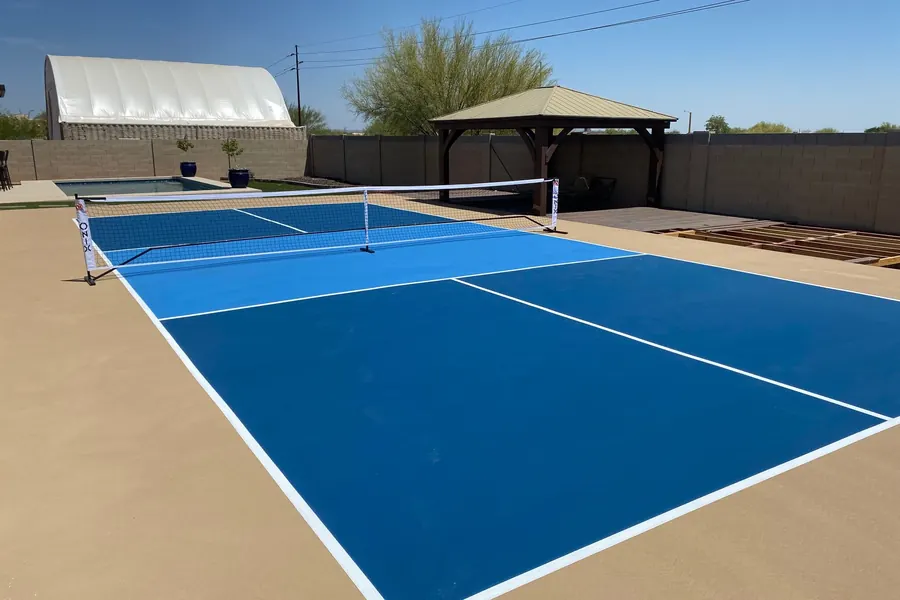
Apex builds one pickleball court behind a house or a row of them for an HOA or club, each on a concrete slab under acrylic color coats.
Tennis courts
A regulation tennis court takes about 60 by 120 feet with its run-off, and a smaller practice layout suits a tight lot.
Basketball and multi-sport courts
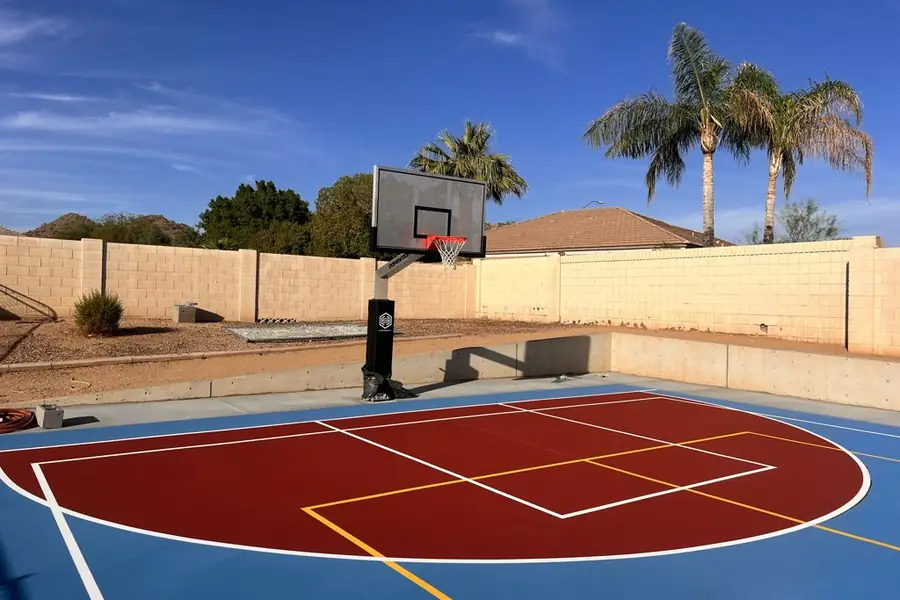
Apex builds basketball half and full courts and multi-sport courts lined for more than one game, the way the city’s Red Mountain Park lines pickleball on its basketball court.
Apex builds bocce courts and padel courts as well.
Court resurfacing in Mesa
A court resurface starts with cleaning, crack filling and leveling low spots, then an acrylic resurfacer smooths the texture before the color coats and new lines for each sport on the court. A recoat keeps to the same temperature limits as a new court. Sunland Village’s guidelines require written approval before any exterior change, concrete coatings included, so check HOA rules for a recoat too.
Converting a sound tennis court to pickleball needs no new slab, since one tennis footprint fits up to four pickleball courts.
| Services | Court construction, court resurfacing and tennis to pickleball conversions |
|---|---|
| Areas served | Mesa, Apache Junction and Gold Canyon. Other cities are on the service area page. |
| Based in | 705 E. Granada Road, Phoenix, AZ 85006 |
| Hours | Monday to Friday, 7:00 AM to 5:00 PM Arizona time |
| Phone | (480) 264-6889 |
| License | Arizona ROC 324026, class KA Dual Engineering, held by Apex Courts Arizona LLC, licensed since 2019 |
Court questions
Does my HOA allow a backyard court?
Can the court fence be chain link?
What limits court lights next to a neighbor?
Which parts of a court need a permit?
When in the year can a court be coated here?
How far is Apex from Mesa and Gold Canyon?
Request a free estimate
Every court is quoted per project, and final pricing depends on court size, existing surface condition, crack repair, drainage and low spots, coating system, colors, striping and site access. Tell us where the court will go, whether it needs lights and whether an HOA reviews it. Call (480) 264-6889 and the owner answers. The consultation is free. Or send the form below and we call you back.