
Building a Court on Caliche? The Sub-Base Prep That Matters
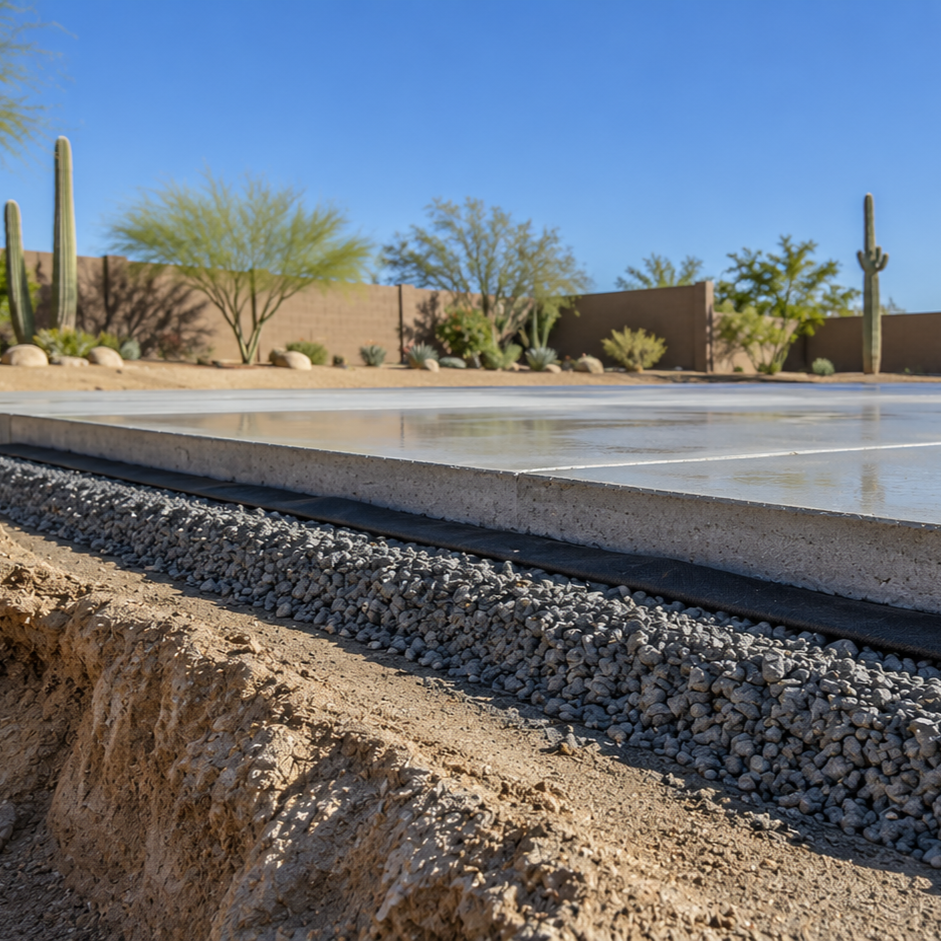
Quick Answer: A court is only as good as what's under it. On caliche, the problem is drainage — the cemented layer won't let water pass, so it perches and undermines the slab. On expansive clay, the problem is movement — the soil swells when wet and shrinks when dry, cracking whatever sits on top. The fix is the same discipline either way: test the soil, excavate to a stable subgrade, build and compact an engineered aggregate base, slope it for drainage, and on problem soils, use post-tensioned concrete to span the movement.
A beautiful court surface is the part you see, but it's not the part that determines how long the court lasts. That comes down to the few feet of dirt and aggregate underneath it. Build a court on Phoenix-area soil without respecting what that soil does, and you'll be looking at cracks within a few seasons, no matter how good the color coat is. Two local soil conditions — caliche and expansive clay — make the sub-base the single most important decision in the whole project.
Cracks Come From the Ground Up
The sports-construction industry is clear on this: cracking is the most common problem with outdoor courts, and the usual root cause is what's beneath the pavement. The American Sports Builders Association attributes settlement cracking specifically to paving over a poorly compacted or poorly drained sub-base, and poor surface conditions to unstable subgrade soils. In other words, most court failures aren't surface failures — they're foundation failures that show up at the surface. That's why a serious court build spends most of its effort below grade, where you'll never see it.
The Two Soil Problems Phoenix Throws at a Court
Around the Valley, two very different soil conditions can wreck a court, and they fail in opposite ways.
Caliche is a layer of soil cemented together by calcium carbonate — a hardpan that ranges from loose nodules to a solid, rock-like slab inches to feet thick, and it's a common problem in southern Arizona soils. Its danger to a court is water. The University of Arizona's extension is direct about it: an impenetrable caliche layer restricts water movement, so water can't drain through and instead perches on top. A court built over undrained caliche sits on a layer that traps water against the base, undermining its stability.
Expansive clay does the opposite — it moves. Clay-rich soils swell when they take on water and shrink when they dry out, and that repeated movement lifts and drops whatever is built on them. The British Geological Survey notes that this shrink-swell behavior causes enormous structural damage nationwide, more than earthquakes, floods, and hurricanes combined in a typical year. A rigid court surface laid over soil that's constantly changing volume will crack as the ground beneath it heaves and settles. Caliche is the dominant challenge on most Valley lots, with expansive soils showing up in pockets — and a soil test is what tells you which you're dealing with.
What Proper Sub-Base Prep Looks Like
Done right, the work below the surface follows a sequence, and skipping steps is where courts fail.
| Step | What it does |
|---|---|
| Soil evaluation | Identifies caliche, clay, and drainage before any digging |
| Excavate to stable subgrade | Removes or breaks through problem soil |
| Engineered aggregate base | A compacted crushed-stone layer that spreads load and drains |
| Compaction in lifts | Built up in layers, each compacted to spec (95% Proctor) |
| Slope for drainage | A true, gentle plane (about 1%) to shed water off the court |
| Moisture control | Drainage to carry water away from and out of the base |
It starts with knowing the soil, because the prep changes depending on what's there. From there, the crew excavates to a sound subgrade — on caliche, that can mean breaking through the hardpan so water has somewhere to go; on clay, removing or stabilizing the problematic soil. Then comes the engineered base: at least several inches of crushed aggregate, built up in layers and compacted to a documented standard rather than just driven over a few times. The whole thing is graded to a true plane with a slope of roughly 1%, so water runs off instead of pooling, and drainage is designed to carry water away from the base entirely. On caliche, that drainage is everything, because the soil itself won't help.
When the Soil Moves, Use Concrete That Doesn't Crack
On expansive or otherwise unstable soils, the base prep is paired with the right slab. Standard concrete and asphalt are vulnerable to ground movement — they crack along joints and weak points as the soil shifts. Post-tensioned concrete is built to resist exactly that: it's a rigid, reinforced slab whose design eliminates the jointing and cracking that plague other surfaces, and it can span unstable soils where asphalt would fail. Regions with expansive soils have used it for decades for that reason. It costs more up front, but over the life of the court, it typically costs less, because it isn't fighting the ground the whole time. Choosing between a standard slab and post-tensioned concrete is a decision driven by the soil report, not by preference.
What Happens If You Skip It
Cutting corners below grade doesn't save money; it defers a bigger bill. A court built on an uncompacted or undrained base settles unevenly and cracks. One built on untreated expansive clay heaves and cracks as the soil cycles wet and dry. Water trapped on caliche undermines the base until the surface fails. And once those cracks start, they don't stay put — they widen and multiply, and the only real cure is resurfacing or rebuilding, which costs far more than doing the base right the first time. The surface you play on is the cheap part to replace; the foundation is the expensive part to fix. A proper court build puts the investment where it actually determines the court's life — underground.
Frequently Asked Questions
Most often because of what's underneath them, not the surface itself. The sports-construction industry attributes settlement cracking to paving over a poorly compacted or poorly drained sub-base, and other cracking to unstable subgrade soils. On Phoenix-area lots, undrained caliche and movement in expansive clay are leading causes. A properly tested, excavated, compacted, and drained base is what prevents it.
Caliche is a hardpan layer where soil is cemented by calcium carbonate, common in southern Arizona and ranging from loose nodules to rock-like slabs. For a court, its danger is drainage: water can't pass through caliche, so it perches on top and undermines the base. Building over it without breaking through and adding drainage traps water against the court's foundation.
Expansive clay swells when wet and shrinks when dry, and that constant movement lifts and drops whatever sits on it, cracking rigid surfaces. Where caliche's problem is trapped water, clay's problem is motion. The fix involves removing or stabilizing the soil, controlling moisture, and often using post-tensioned concrete, which is designed to span soil that moves.
Yes, it's the step that determines everything else. A soil evaluation tells you what you're dealing with — caliche, expansive clay, or both- and the right excavation, drainage, base, and slab all depend on that answer. Building without it is guessing, and on Phoenix soils, a wrong guess shows up as cracks within a few seasons.
On unstable or expansive soils, usually yes. Post-tensioned concrete is engineered to resist cracking caused by ground movement, and it can span soils where asphalt or a standard slab would fail. It costs more up front but often less over the life of the court because it needs far less crack repair and resurfacing. The soil report is what justifies the choice.
Critical, especially on caliche that won't drain on its own. A court is built to a true plane with a gentle slope, about 1%, so water sheds off the surface rather than pooling, and the base is designed to carry water away. Poor drainage is a documented cause of base instability and cracking, so getting water off and away is central to the entire build.
The Court You Don't See Decides the One You Do
A great playing surface laid over bad ground is a crack waiting to happen. On Phoenix-area soils, that means respecting what caliche and expansive clay actually do — one traps water, the other moves — and building a sub-base that handles both: tested, excavated, compacted, drained, and topped with the right slab for the soil. Spend where it counts, below grade, and the court plays true for decades. Skip it, and you'll pay for it at the surface, again and again.
Planning a court on Phoenix-area soil? — Start with a soil evaluation and a sub-base built for caliche and clay, so your court doesn't crack in a few seasons. Apex Court Builders serves Phoenix and across Arizona. Call (480) 264-6889.
