
Acrylic vs Cushioned Courts: Which Survives Extreme Heat?
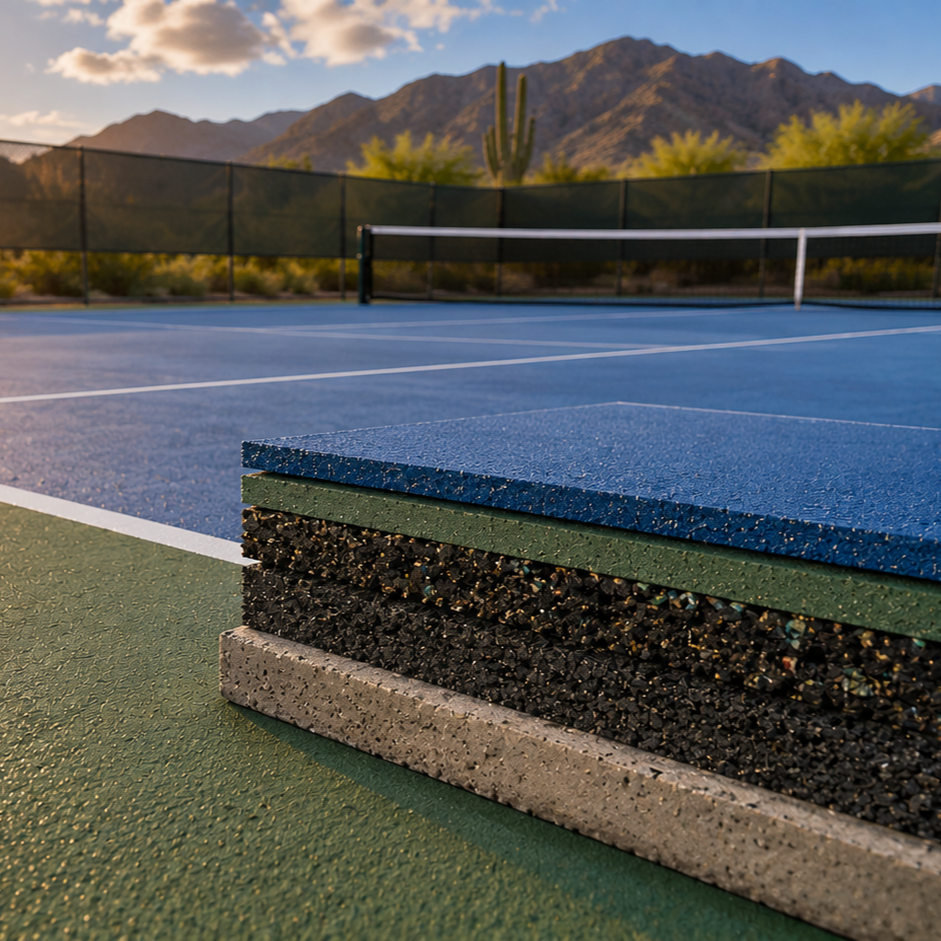
Quick Answer: A standard acrylic (hard) court is a thin system of acrylic coatings over asphalt or concrete — durable, low-maintenance, and proven in hot climates, but firm underfoot. A cushioned court adds one or more rubber layers under the acrylic for shock absorption that's easier on joints, but those extra layers mean more to maintain and a system that's more sensitive to heat and installation quality. In Arizona's extreme heat, acrylic is the lower-maintenance workhorse; cushioned trades some durability and upkeep for comfort.
When you're building or resurfacing a court in Arizona, the surface has to survive brutal sun, big temperature swings, and years of UV exposure. Acrylic and cushioned systems both do the job, but they hold up differently under that heat and ask different things of you over time. The right call depends on how much you value comfort underfoot versus the lowest possible maintenance, and on how the surface is built, as much as on which type you pick.
What Each Surface Is
A standard acrylic court — the classic "hard court" — is built from layers of acrylic coating applied over a paved base of asphalt or concrete. The acrylic provides the color, the texture, and the playing speed, while the base provides the strength. It's a thin, tough system with a long track record, and it's what most public and tournament hard courts use.
A cushioned court starts with the same idea but adds resilience beneath: one or more layers of rubber granules built into the system beneath the acrylic top coats. Those layers flex slightly underfoot, absorbing shock so the surface is softer on the knees, joints, and back. The more cushioning layers, the more give — and the more complex the system.
How They Hold Up in Heat
This is where the desert climate matters. Both systems are designed to take the sun and weather, but they age differently.
An acrylic hard court is simple and tough. With fewer, thinner layers and a solid paved base, there's less in the system to be affected by heat cycling, and acrylic coatings are made to resist UV and wear. That simplicity is why acrylic tends to be the lower-maintenance choice in a hot climate — it holds color and texture well and asks mostly for periodic resurfacing.
A cushioned court has more layers, and more layers mean more interfaces that the daily heat-and-cool cycle works on over the years. The rubber cushioning system performs well when it's installed correctly on a sound base, but it's a more involved build, and a more complex system generally needs more attention to keep performing and looking right. In extreme heat, especially, installation quality and proper base preparation make a big difference in how long a cushioned court stays sound.
Color and texture choices factor in here as well. Darker surface colors absorb more heat and run hotter underfoot, while lighter colors stay cooler — a real consideration on a court that bakes in the Arizona sun all afternoon. The texture and the acrylic top coats also wear under heavy play and UV, so both systems benefit from periodic resurfacing to keep the color, grip, and playing speed consistent. The difference is mostly in how often and how involved that upkeep is, with the simpler acrylic system generally asking for less. Planning for that maintenance from the start — rather than treating the court as install-it-and-forget-it — is what keeps either surface playing well and looking sharp for years in this climate.
| Factor | Acrylic (Hard) | Cushioned |
|---|---|---|
| Build | Thin acrylic over asphalt/concrete | Rubber cushion layers under acrylic |
| Feel underfoot | Firm | Softer, easier on joints |
| Maintenance | Lower; periodic resurfacing | Higher; more complex system |
| Heat/UV durability | Very durable, proven | Durable, more install-dependent |
| Best for | Low-maintenance, high-traffic courts | Comfort and joint-friendliness |
Which One Fits Your Court
It comes down to what you're optimizing for. If you want the most durable, lowest-maintenance surface that shrugs off the sun and high traffic — a public court, a hard-use home court, or anywhere upkeep needs to be minimal — an acrylic hard court is the proven, practical pick in Arizona's climate. It's firm to play on, but that firmness is part of what makes it so durable.
If comfort matters more — a home court where players want it easier on the knees and joints, or anyone playing long sessions who feels the hard surface — a cushioned court delivers real comfort that a hard court can't, and it can absolutely hold up in heat when it's built right. The trade is more maintenance-intensive over its life and has a stronger dependence on quality installation. Either way, the single biggest factor in how long the surface lasts in extreme heat is the base preparation and the quality of the install, so the builder matters as much as the surface type. A proper evaluation of your site, use, and goals is what turns this into a clear choice.
Frequently Asked Questions
An acrylic (hard) court is a thin acrylic coating over an asphalt or concrete base — firm, durable, and low-maintenance. A cushioned court adds rubber layers beneath the acrylic to absorb shock, making it softer on the joints. Acrylic is the simpler, lower-maintenance system; cushioned trades more maintenance and a more complex build for comfort underfoot.
Acrylic hard courts tend to be the more durable, lower-maintenance choice in extreme heat because the system is simpler — fewer, thinner layers over a solid base, with UV-resistant acrylic. Cushioned courts can also hold up well in heat, but their extra layers make them more dependent on quality installation and somewhat more maintenance-intensive over time. Base prep and install quality matter most for both.
It depends on what you value. If comfort and ease on the knees and joints matter — especially for long sessions or on a home court — a cushioned surface offers a softer feel that a hard court can't match. The trade-off is more maintenance and a stronger reliance on a quality build. If lowest maintenance and maximum durability are the priority, acrylic is usually the better fit.
Like any outdoor surface in the desert sun, an acrylic court heats up, and color choice and surrounding conditions affect how much. But acrylic systems are designed and widely used in hot climates and hold up to the heat well. Scheduling play for cooler parts of the day helps with comfort, while the surface itself is built to take the sun.
Base preparation and installation quality are more important than the surface type alone. A well-prepared, sound base and a correct, professional installation are what allow either an acrylic or a cushioned court to withstand years of extreme heat, UV, and temperature swings. A poorly built court of either type will fail early, which is why the builder and the base matter as much as which system you choose.
Match the Surface to How You'll Use It
Acrylic and cushioned courts aren't really competing for the same job. Acrylic is the durable, low-maintenance workhorse that takes Arizona's heat in stride and asks little in return. Cushioned is the comfort option that's easier on the body, at the cost of more upkeep and a greater dependence on a quality build. Decide whether durability or comfort is the priority for your court, then focus on the base and installation — that's what makes either one last in the desert.
Planning a new court or a resurface in the Arizona heat? — Get an honest recommendation matched to your use, comfort, and maintenance goals. Apex Court Builders serves Phoenix and across Arizona. Call (480) 264-6889.
