
Post-Tensioned vs Standard Concrete: Which Court Resists Cracking?
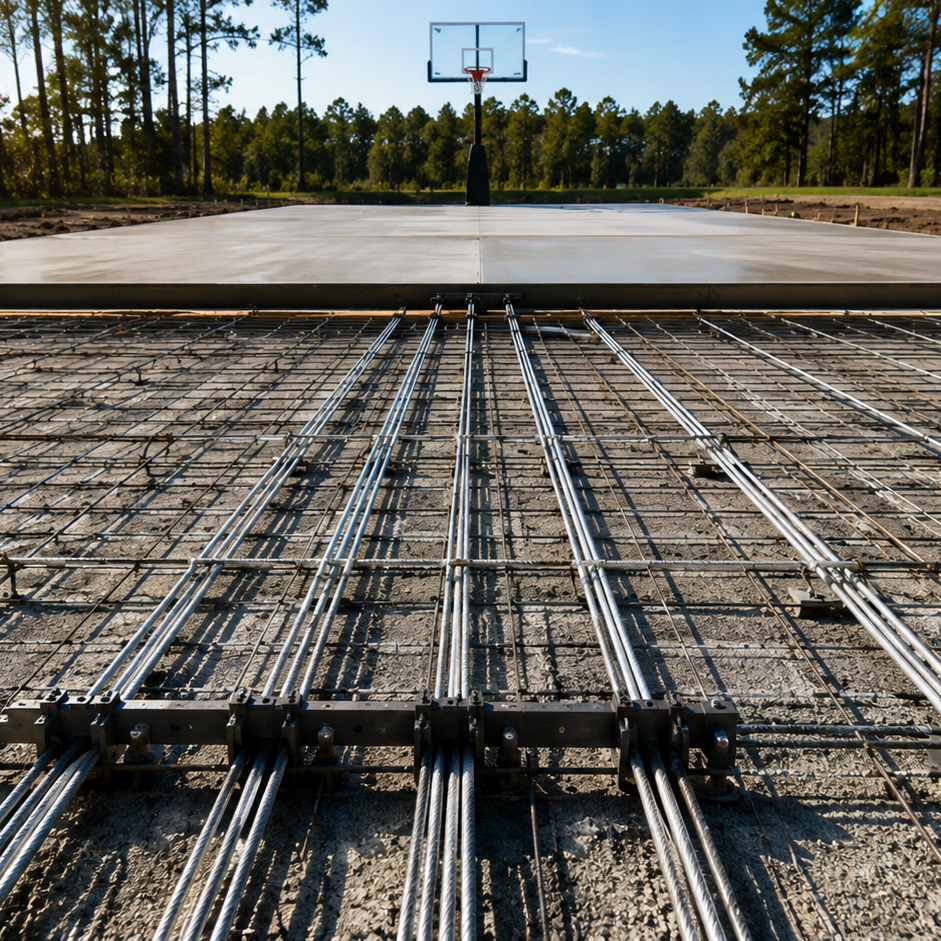
Quick Answer: Post-tensioned concrete generally resists cracking better than standard concrete for an outdoor court, which is why it's often preferred for courts, especially on challenging soils. A post-tensioned slab has steel cables (tendons) running through it that are tensioned after the concrete cures, compressing the slab and holding it together as one strong, unified unit that resists the cracking concrete is prone to. Standard concrete relies on reinforcement and control joints but is more susceptible to cracking from soil movement, shrinkage, and expansion. Because cracks in a court surface are a major concern — they telegraph through the playing surface — the superior crack resistance of post-tensioned concrete is a key advantage for a long-lasting court.
When building an outdoor court, the concrete base is the foundation everything depends on — and the biggest enemy of a long-lasting court is cracking. Cracks in the base telegraph up through the playing surface, so choosing a base that resists them matters. The two main options, post-tensioned and standard concrete, handle cracking differently, and understanding why helps you choose the better foundation.
For a court, cracking is the problem that matters most. The concrete base supports the acrylic surface, and when the base cracks, those cracks tend to telegraph up through the surface coating, marring the playing surface and creating maintenance headaches that are difficult to fully resolve. Concrete naturally wants to crack — it shrinks as it cures, moves with temperature changes, and is affected by the soil beneath it, especially expansive or shifting soils. So the real question in choosing a base is which type better resists the cracking that would otherwise compromise the court. That's where post-tensioned and standard concrete differ.
Why Cracking Is the Central Concern
For a court, cracking is the problem that matters most. The concrete base supports the acrylic surface, and when the base cracks, those cracks tend to telegraph up through the surface coating, marring the playing surface and creating maintenance headaches that are difficult to fully resolve. Concrete naturally wants to crack — it shrinks as it cures, moves with temperature changes, and is affected by the soil beneath it, especially expansive or shifting soils. So the real question in choosing a base is which type better resists the cracking that would otherwise compromise the court. That's where post-tensioned and standard concrete differ.
How Standard Concrete Works
Standard (conventionally reinforced) concrete is the familiar approach: a concrete slab, typically reinforced with steel rebar or wire mesh, with control joints cut in to manage where cracking occurs. The reinforcement adds strength, and the control joints are designed to direct cracking to planned lines rather than random ones. However, standard concrete remains more susceptible to cracking overall — from shrinkage, from expansion and contraction, and especially from soil movement beneath it. On challenging soils or in conditions that stress the slab, standard concrete is more likely to develop cracks that can affect the court surface.
How Post-Tensioned Concrete Works
Post-tensioned concrete takes a different approach to resisting cracks. The slab has steel cables, called tendons, running through it, and after the concrete has cured, those cables are tensioned (tightened), which puts the entire slab under compression. This compression actively holds the concrete together as one unified, monolithic unit, counteracting the forces that cause cracking. Because the slab is compressed and tied together, it resists cracking from shrinkage, movement, and soil shifts far better than a standard slab. It essentially keeps the concrete squeezed together so it doesn't pull apart into cracks. This is why post-tensioned slabs are known for superior crack resistance.
| Factor | Standard Concrete | Post-Tensioned Concrete |
|---|---|---|
| Reinforcement | Rebar or wire mesh | Tensioned steel tendons |
| Crack resistance | More susceptible to cracking | Strong crack resistance |
| On expansive/shifting soil | More prone to cracking | Better resists soil movement |
| Behavior | Relies on joints to manage cracks | Compressed into a unified slab |
| Common use for courts | Used, but less crack-resistant | Often preferred for durability |
Which Resists Cracking Better
Specifically for crack resistance, post-tensioned concrete is generally the stronger performer, which is why it's often preferred for outdoor courts, particularly where soil conditions are challenging. The compression that holds the slab together gives it a real advantage in resisting cracking, the main threat to a court surface. Standard concrete can still be used for courts and can perform adequately with proper reinforcement, joints, and base preparation, but it's inherently more susceptible to cracking than a post-tensioned slab. So when the priority is minimizing cracks for a durable, long-lasting court — especially on expansive or shifting soils — post-tensioned concrete has the edge.
The soil under your court matters as much as the concrete on top. On expansive or shifting soils, which move and stress a slab, the crack resistance of post-tensioned concrete is especially valuable. Discuss your site's soil conditions when choosing a base, since they strongly influence which option will hold up best.
Why the Base Choice Is a Long-Term Decision
The base is the long-term foundation of the court, and unlike the acrylic surface — which is a renewable wear layer that gets resurfaced periodically — the concrete base is meant to last for the life of the court. So choosing a base that resists cracking is a decision that affects the court for decades. A base that cracks creates problems that telegraph through every resurfacing, while a sound, crack-resistant base supports a court that stays smooth and playable over many surface renewals. This is why the crack resistance of the base material is such an important consideration, and why post-tensioned concrete is frequently chosen for courts where long-term durability is the goal. A court builder can assess your site, soil, and needs to recommend the right base for a lasting court.
Frequently Asked Questions
Post-tensioned concrete generally resists cracking better. Its tensioned steel tendons compress the slab and hold it together as one unified unit, counteracting the forces that cause cracking from shrinkage, movement, and soil shifts. Standard concrete relies on reinforcement and control joints, but remains more susceptible to cracking. For crack resistance, especially on challenging soils, post-tensioned has the advantage.
Because the concrete base supports the acrylic surface, and when the base cracks, those cracks telegraph up through the surface coating, marring the playing surface and creating maintenance problems that are hard to fully resolve. Since cracks compromise the court's appearance and playability, resisting them is a central concern, making the crack resistance of the base a key factor in building a lasting court.
It has steel cables, called tendons, running through the slab. After the concrete cures, those cables are tensioned, putting the entire slab under compression. This compression holds the concrete together as one unified, monolithic unit, counteracting the forces that cause cracking. By keeping the slab compressed, it resists cracking from shrinkage, movement, and soil shifts far better than a standard slab.
It can be used and can perform adequately with proper reinforcement, control joints, and base preparation. However, standard concrete is inherently more susceptible to cracking than post-tensioned concrete, particularly on expansive or shifting soils. So while standard concrete is an option, post-tensioned concrete is often preferred when minimizing cracks and getting the most long-term durability is the priority for the court.
Yes, significantly. Expansive or shifting soils move and stress a concrete slab, increasing the risk of cracking. On such soils, the superior crack resistance of post-tensioned concrete is especially valuable, since it better resists the cracking that soil movement causes. Your site's soil conditions strongly influence which base will hold up best, so they're an important part of the decision.
Yes. Unlike the acrylic surface, which is a renewable wear layer resurfaced periodically, the concrete base is meant to last for the life of the court. So choosing a crack-resistant base affects the court for decades — a cracking base creates problems through every resurfacing, while a sound base supports a smooth, playable court over many surface renewals. That's why the base choice is such an important long-term decision.
Choose the Base That Holds Together
For an outdoor court, where cracking is the main threat, post-tensioned concrete generally resists cracking better than standard concrete, because its tensioned tendons compress the slab into a unified, crack-resistant unit — an advantage that's especially valuable on expansive or shifting soils. Since the base is the long-term foundation that supports every resurfacing, choosing a crack-resistant base is a decision that pays off for decades. A court builder can assess your site and recommend the right foundation.
Building an outdoor court and want a crack-resistant base — Get your site and soil assessed for the right concrete foundation. Apex Court Builders serves Phoenix and across Arizona. Call (480) 264-6889.
